
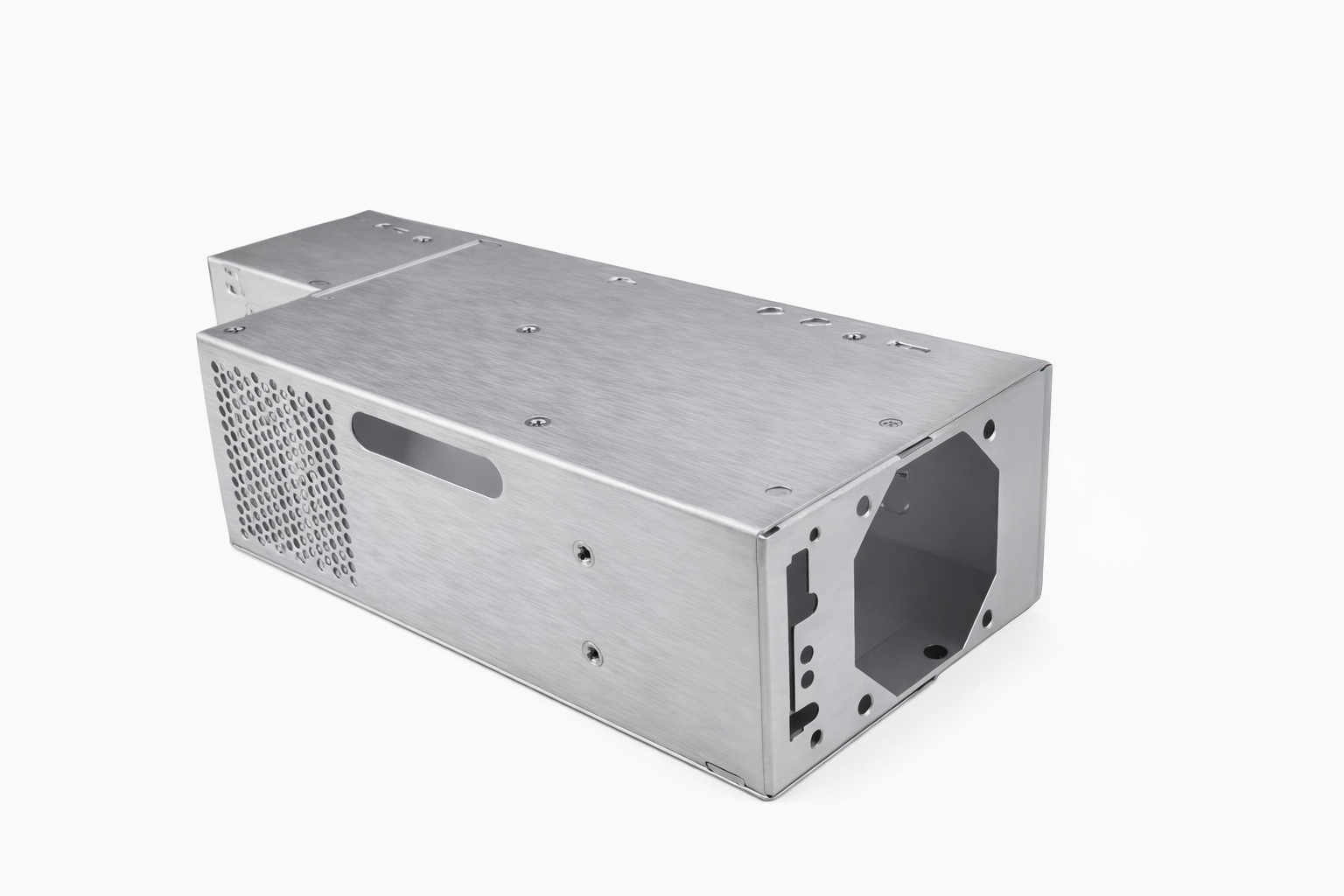
CNC NCT 터렛 펀칭 판금 가공 전자 장비 섀시 제조 공정
통신 네트워크 장비, 서버 인프라, 산업용 전자 하우징의 구조물은 단순한 외장 부품이 아니라 기계적 강성, 전자파 차폐, 열 관리, 조립 정밀도를 동시에 만족해야 하는 고기능 구조물입니다. 이러한 제품군은 대부분 판금 구조로 설계되며, 그 중심 공정 중 하나가 CNC NCT 터렛 펀칭 판금 가공입니다.
NCT(Numerical Control Turret) 펀칭은 다수의 펀치와 다이를 회전 터렛에 장착한 상태에서 CNC 제어를 통해 판재의 위치 이동과 펀칭 스트로크를 반복 수행하는 방식의 판금 가공 기술입니다. 이 공정은 대량의 홀 패턴과 기능성 구조가 포함된 전자 장비 하우징 생산에서 높은 생산성과 반복 정밀도를 확보할 수 있는 특징을 가지고 있습니다.
특히 서버 랙, 네트워크 장비 섀시, 전원 장치 케이스와 같은 제품은 통풍 구조, 체결 홀, 케이블 라우팅 슬롯, 접지 포인트와 같은 기능성 구조가 복합적으로 배치됩니다. 이러한 구조들은 설계 데이터와 동일한 위치 정확도로 반복 가공되어야 하며, NCT 터렛 펀칭 공정은 이러한 요구 조건을 안정적으로 만족시키는 판금 제조 기술입니다.
CNC NCT 터렛 펀칭 가공의 기술적 개념
CNC 터렛 펀칭 장비는 다양한 형상의 펀치와 다이를 터렛 디스크에 장착하고, CNC 제어 시스템을 통해 판재의 X-Y 좌표 이동과 펀칭 램 스트로크를 자동으로 수행하는 장비입니다.
장비는 일반적으로 서보 모터 기반 위치 제어 시스템과 고강성 프레임 구조로 구성되어 있으며, 반복 가공 시에도 높은 위치 정확도와 공정 안정성을 유지할 수 있습니다.
펀치가 하강하면서 금속 판재는 다이 캐비티 방향으로 전단되며, 이 과정에서 슬러그가 제거됩니다. 이러한 전단 가공은 금속 판재를 절단하는 동시에 다양한 기능성 형상을 구현할 수 있다는 특징이 있습니다.
터렛 펀칭 장비는 홀 가공뿐 아니라 루버 형성, 엠보싱, 익스트루전 성형, 탭 가공 등 다양한 기능을 동일 장비에서 수행할 수 있습니다. 이와 같은 공정 통합 특성은 판금 부품 생산 과정에서 공정 수를 줄이고 생산 효율을 향상시키는 요소로 작용합니다.
또한 공구 교환 없이 터렛 회전을 통해 다양한 공구를 즉시 사용할 수 있기 때문에 반복 패턴이 많은 전자 장비 판금 제품 생산에 매우 적합합니다.
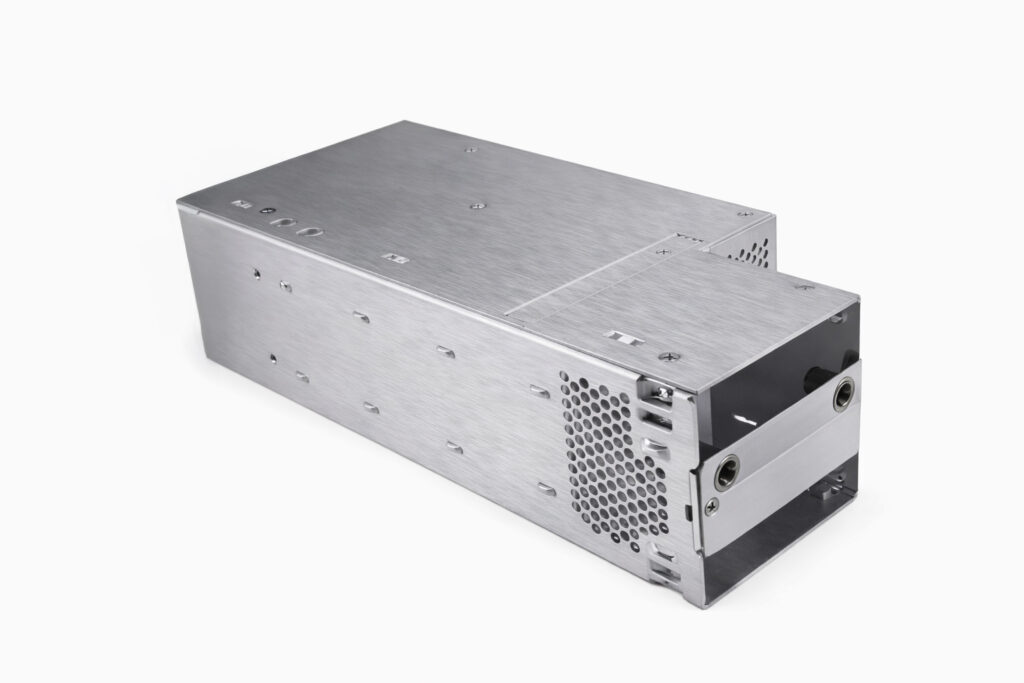
통신 장비와 서버 섀시에서 NCT 가공이 중요한 이유
데이터센터 인프라와 통신 장비는 높은 신뢰성과 안정적인 구조 설계를 요구합니다. 서버 섀시와 네트워크 랙 구조물은 내부에 다양한 전자 모듈이 장착되며, 장비 간 정밀한 정렬과 안정적인 고정 구조가 필요합니다.
이러한 구조물에는 다음과 같은 기능성 요소들이 포함됩니다.
통풍을 위한 고밀도 에어홀 패턴
케이블 라우팅을 위한 슬롯 구조
접지 연결을 위한 체결 포인트
전자파 차폐 성능을 위한 구조적 접촉면
이러한 기능성 구조는 설계 데이터와 정확하게 일치하는 위치에 가공되어야 하며, 반복 가공 시에도 동일한 정밀도를 유지해야 합니다.
NCT 터렛 펀칭 공정은 CNC 좌표 제어를 기반으로 하기 때문에 이러한 반복 패턴 가공에서 매우 안정적인 위치 정밀도를 확보할 수 있습니다. 또한 동일 공구를 이용한 반복 가공이 가능하기 때문에 생산 품질의 일관성을 유지할 수 있습니다.
NCT 터렛 펀칭 판금 가공 공정 흐름
CNC NCT 판금 가공은 여러 단계의 제조 공정을 통해 완성됩니다. 각 단계는 판금 구조물의 품질과 생산 효율을 결정하는 중요한 요소입니다.
먼저 원자재 준비 단계가 진행됩니다.
서버 섀시나 네트워크 장비용 판금 제품에는 냉간압연강판, 아연도금강판, 알루미늄 합금 등이 주로 사용됩니다.
판재 두께는 일반적으로 0.8mm에서 2.0mm 범위가 가장 많이 사용되며, 장비 구조 강성과 경량화 요구에 따라 소재 선택이 달라집니다.
소재의 전단 강도와 연성 특성은 펀칭 하중과 공구 마모에 직접적인 영향을 주기 때문에 소재 특성 분석이 중요합니다.
다음 단계는 CAM 기반 가공 프로그램 작성입니다.
CAD 설계 데이터를 기반으로 CAM 소프트웨어에서 공구 선택, 펀칭 순서, 시트 이동 경로 등이 결정됩니다.
특히 타격 순서는 판재 변형을 제어하는 핵심 요소입니다. 동일 위치에 연속 타격이 집중될 경우 판재에 응력이 집중되어 평탄도 문제가 발생할 수 있습니다.
이러한 문제를 방지하기 위해 분산 타격 전략과 가공 순서 최적화가 적용됩니다.
이후 실제 펀칭 가공이 진행됩니다.
클램핑 장치에 의해 고정된 판재는 CNC 좌표 제어에 따라 이동하며, 선택된 공구가 램 스트로크를 통해 펀칭 작업을 수행합니다.
펀치가 하강하면서 판재는 다이 방향으로 전단되고, 슬러그가 제거된 후 램이 상승하며 다음 위치로 이동합니다.
이러한 과정이 프로그램에 따라 반복적으로 수행됩니다.
대형 개구부나 곡선 형상은 니블링 가공 방식으로 구현됩니다.
니블링은 작은 펀치를 이용하여 다중 타격을 통해 형상을 형성하는 방식입니다. CNC 제어를 통해 타격 간격과 경로가 정밀하게 제어되며, 복잡한 형상도 안정적으로 가공할 수 있습니다.
펀칭 공정 이후에는 후공정이 진행됩니다.
대표적인 후공정에는 디버링, 벤딩, 탭 가공, 용접 등이 포함됩니다.
터렛 펀칭에서 형성된 위치 정밀도는 이러한 후공정 조립 품질에 직접적인 영향을 미치며, 조립 공정의 정렬 정확도를 결정하는 중요한 요소입니다.
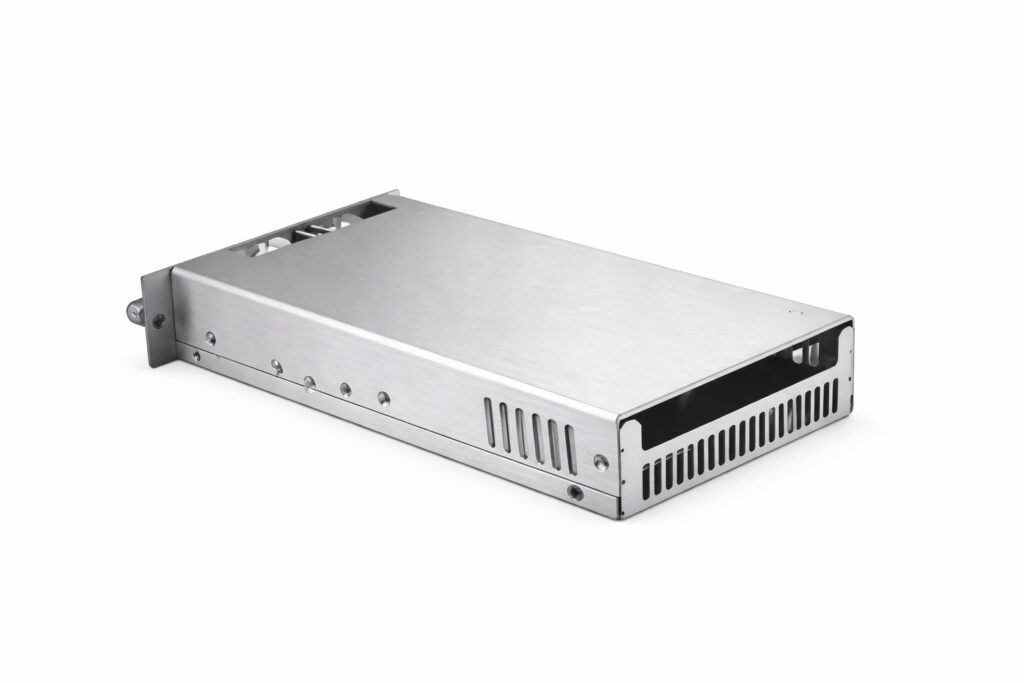
터렛 펀칭 가공에서 중요한 공정 변수
NCT 판금 가공에서는 다양한 공정 변수들이 가공 품질에 영향을 미칩니다.
먼저 펀치와 다이 사이의 간극 설정이 매우 중요합니다.
이 간극은 일반적으로 판재 두께의 약 5%에서 10% 수준으로 설정됩니다.
간극이 너무 좁을 경우 공구 마모가 빠르게 진행될 수 있으며, 반대로 간극이 과도하게 넓으면 버 발생이 증가하고 전단면 품질이 저하됩니다.
타격 순서 역시 중요한 요소입니다.
펀칭 공정은 타격 기반 공정이기 때문에 반복적인 충격이 판재 응력에 영향을 미칩니다.
따라서 타격 순서를 적절히 설계하여 응력 분포를 분산시키는 것이 필요합니다.
공구 마모 상태도 품질에 큰 영향을 미칩니다.
공구가 마모될 경우 홀 형상 정확도가 떨어지고 버 발생이나 테이퍼 현상이 나타날 수 있습니다.
따라서 공구 상태를 지속적으로 관리하는 것이 중요합니다.
니블링 가공에서는 타격 간격이 형상 품질에 영향을 줍니다.
피치가 너무 넓을 경우 가장자리 거칠기가 증가할 수 있으며, 적절한 피치 설정을 통해 가공 품질을 유지할 수 있습니다.
또한 클램핑 안정성 역시 중요한 요소입니다.
판재 고정이 안정적으로 이루어지지 않을 경우 위치 오차가 발생할 수 있으며, 반복 정밀도에도 영향을 줄 수 있습니다.
전자 장비 판금 구조 설계와 터렛 펀칭의 연계
현대 전자 장비 하우징은 단순한 보호 케이스가 아니라 다양한 기능을 수행하는 구조 부품입니다.
대표적인 기능에는 다음과 같은 요소가 포함됩니다.
고밀도 통풍 패턴을 통한 열 관리 구조
전자파 차폐 성능을 위한 접지 구조
경량화를 위한 성형 리브 구조
모듈형 조립을 위한 탭 및 힌지 구조
터렛 펀칭 장비는 이러한 기능성 구조를 다양한 공구 조합을 통해 동일 장비에서 구현할 수 있습니다.
예를 들어 루버 성형은 공기 흐름을 위한 통풍 구조를 형성할 수 있으며, 엠보싱 구조는 판재 강성을 높이는 역할을 합니다.
또한 익스트루전 성형은 체결 강도를 높이는 구조 형성에 사용됩니다.
이러한 기능성 성형을 펀칭 공정과 동시에 수행할 수 있기 때문에 공정 효율과 제품 기능을 동시에 확보할 수 있습니다.
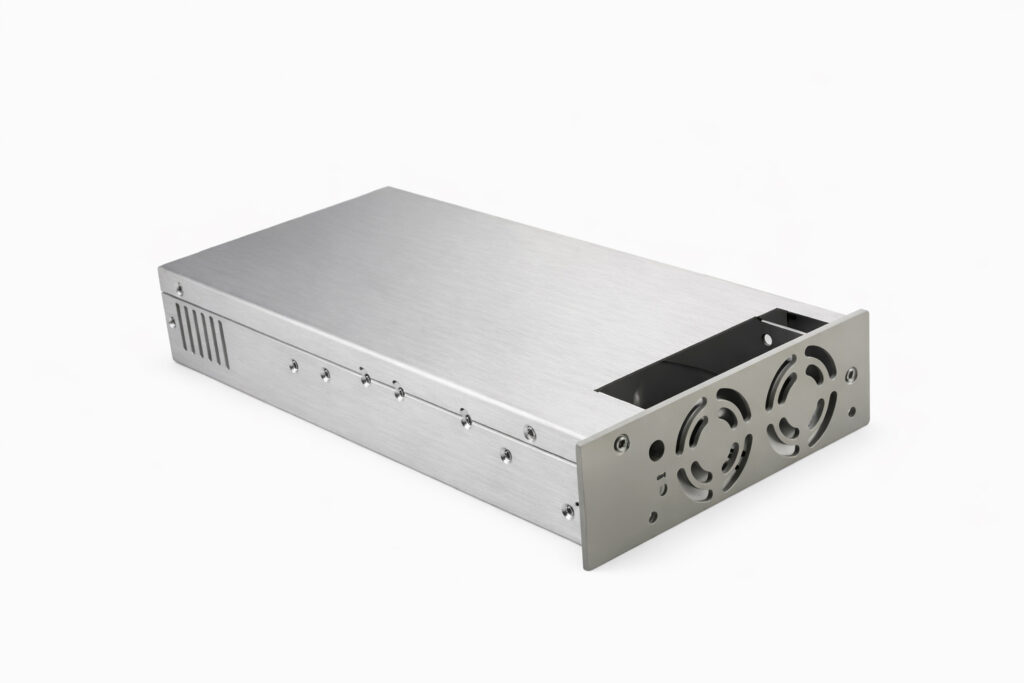
CNC NCT 판금 가공의 생산성과 산업적 활용
터렛 펀칭 공정은 다품종 중량 생산 환경에서 매우 높은 공정 유연성을 제공합니다.
표준 공구를 이용한 가공이 가능하기 때문에 전용 금형 제작이 필요하지 않은 경우가 많으며, 제품 변경 시에도 프로그램 수정만으로 생산 전환이 가능합니다.
이러한 특성은 다음과 같은 산업 분야에서 매우 중요한 장점으로 작용합니다.
데이터센터 서버 섀시 제조
통신 장비 랙 패널 생산
전원 장치 케이스 제작
산업용 컨트롤러 하우징 생산
특히 반복 홀 패턴이 많은 판금 구조물에서는 레이저 절단 공정보다 가공 속도와 비용 측면에서 효율적인 경우가 많습니다.
또한 CAM 기반 가공 전략과 자동화 장비의 발전은 터렛 펀칭 공정의 반복 정밀도와 생산 효율을 지속적으로 향상시키고 있습니다.
현대 제조 환경에서는 공정 자동화, 데이터 기반 가공 전략, 공구 관리 기술이 결합되면서 터렛 펀칭 공정의 적용 범위가 더욱 확대되고 있습니다.
CNC NCT 터렛 펀칭 판금 가공 기술의 제조 경쟁력
전자 장비 산업에서는 제품 구조의 고밀도화와 모듈화 설계가 지속적으로 강화되고 있습니다.
이에 따라 판금 구조물에는 경량화, 강성 확보, 열 관리, 전자파 차폐 성능이 동시에 요구됩니다.
CNC NCT 터렛 펀칭 판금 가공은 이러한 요구 사항을 만족시키는 제조 기술로 활용되고 있습니다.
특히 다양한 공구 조합을 활용하여 절단, 성형, 니블링, 기능성 구조 가공을 하나의 장비에서 수행할 수 있다는 점은 공정 집약도와 생산 효율을 동시에 확보할 수 있는 요소입니다.
또한 CNC 기반 가공 제어와 CAM 공정 설계 기술이 결합되면서 터렛 펀칭 공정은 단순한 홀 가공 장비의 범위를 넘어 판금 구조물 제조 전반을 담당하는 핵심 가공 기술로 활용되고 있습니다.
데이터센터 인프라, 통신 장비, 산업용 전자 시스템 등 다양한 산업 분야에서 CNC NCT 판금 가공 기술은 구조적 정밀도와 생산 효율을 동시에 확보하는 판금 제조 공정으로 활용되고 있습니다.
CNC NCT Turret Punching Sheet Metal Processing for Electronic Equipment Chassis Manufacturing
In the manufacturing of communication network equipment, server infrastructure, and industrial electronic enclosures, sheet metal structures are not merely exterior components but structural elements that must simultaneously satisfy mechanical rigidity, electromagnetic shielding, thermal management, and assembly precision. For these types of products, CNC NCT turret punching sheet metal processing plays a central role in achieving high production efficiency and structural accuracy.
NCT (Numerical Control Turret) punching is a sheet metal fabrication technology in which multiple punch and die tools are mounted on a rotating turret and controlled through CNC positioning systems. By coordinating sheet positioning in the X–Y axis with ram stroke operations, the process repeatedly generates holes, slots, ventilation structures, and forming features.
This method is particularly effective in the production of electronic housings where repetitive patterns and functional structures are densely distributed. Server racks, communication equipment chassis, and power supply enclosures contain ventilation openings, fastening points, cable routing slots, and grounding features. These components must be manufactured with precise positional consistency, and NCT turret punching provides the repeatability and accuracy required for such applications.
Technical Principles of CNC NCT Turret Punching
CNC turret punching machines are designed with a rotating turret disk containing a variety of punch and die tools. The machine automatically selects tools based on the programmed operation sequence, allowing multiple forming and cutting processes to be executed without manual tool changes.
The system typically incorporates servo-controlled positioning units and a high-rigidity machine frame. These features allow the equipment to maintain stable punching accuracy even during high-speed repetitive operations.
During punching, the punch descends toward the die cavity and shears the sheet metal, removing a slug from the material. This shearing process allows holes and structural features to be produced with high dimensional accuracy.
Unlike many other sheet metal processes, turret punching is capable of performing multiple functions within a single machine. In addition to simple hole punching, the equipment can also perform louver forming, embossing, extrusion features, and various structural forming operations.
Because the turret can rotate to bring different tools into position instantly, the system is highly efficient when producing parts that contain repetitive patterns, such as ventilation holes or mounting arrays used in electronic equipment chassis.
Importance of NCT Processing in Server and Communication Equipment
Server enclosures and communication network racks require high reliability and structural stability. These products often support heavy electronic modules and must maintain precise alignment during assembly and operation.
The sheet metal structures used in these products typically include several types of functional features.
Ventilation hole patterns designed for airflow and thermal dissipation
Cable routing slots for internal wiring management
Grounding points used for electromagnetic compatibility
Mounting holes and structural attachment points for modular assembly
Each of these elements must be positioned precisely according to the original design data. Even minor deviations in hole position can influence assembly alignment and electromagnetic shielding performance.
Because CNC turret punching uses coordinate-controlled positioning, it ensures that repeated hole patterns maintain consistent spacing and accuracy throughout the entire sheet.
Manufacturing Workflow of NCT Turret Punching Sheet Metal Processing
CNC NCT sheet metal fabrication consists of several stages, each of which influences the structural quality and production efficiency of the final product.
The process begins with raw material preparation.
Sheet materials used for server chassis and communication equipment typically include cold-rolled steel, galvanized steel, and aluminum alloys. These materials provide the mechanical strength and corrosion resistance required for electronic enclosure structures.
Sheet thickness commonly ranges between 0.8 mm and 2.0 mm depending on the structural requirements of the product. Material properties such as shear strength and ductility influence punching force and tool wear characteristics, making material selection an important early step in the process.
After material preparation, CAM-based programming is performed.
Using CAD design data, CAM software determines the punching tool selection, punching sequence, and sheet repositioning strategy. The punching sequence is particularly important because it affects the stress distribution within the sheet metal.
If repeated punches are concentrated within a small area, localized stress accumulation can cause deformation or warping of the sheet. To prevent such issues, distributed punching strategies and optimized tool paths are implemented during program planning.
Once programming is completed, the sheet is clamped securely in the machine.
The CNC positioning system moves the sheet according to programmed coordinates, while the selected tool performs punching operations through ram strokes. After each punch, the slug is ejected and the ram retracts before the sheet moves to the next position.
This sequence is repeated automatically according to the programmed process.
For large openings or curved contours, nibbling operations are often used.
Nibbling involves performing a series of overlapping punches using a smaller tool to gradually form the desired shape. Because the punching positions are precisely controlled by CNC coordinates, even complex geometries can be produced with consistent dimensional accuracy.
Following punching operations, several secondary processes may be required.
These processes may include deburring, tapping, bending, welding, or surface finishing. The positional accuracy created during turret punching directly affects the alignment and assembly precision during these subsequent manufacturing stages.
Key Process Factors Affecting Turret Punching Quality
Several process variables play critical roles in determining the quality of turret punching sheet metal components.
One of the most important factors is the clearance between the punch and die.
This clearance is typically set to approximately five to ten percent of the sheet thickness. Proper clearance ensures that the shearing process produces a clean cut edge while minimizing burr formation.
If the clearance is too small, excessive tool wear may occur due to increased punching force. If the clearance is too large, burr formation and poor edge quality can result.
Punching sequence is another important consideration.
Because turret punching is an impact-based process, repeated punching operations introduce stress into the sheet material. Carefully planned punching sequences help distribute these stresses and prevent distortion.
Tool wear is also a significant factor influencing hole quality.
As punch tools wear over time, the edges may lose sharpness, which can lead to burr formation or tapered hole profiles. Regular tool maintenance and monitoring are therefore essential to maintain consistent product quality.
In nibbling operations, the pitch between successive punches influences the smoothness of the contour edge.
A larger pitch may result in rougher edges, while a smaller pitch improves contour quality but increases processing time. Optimal pitch settings are selected to balance productivity and surface quality.
Another important element is sheet clamping stability.
If the sheet is not held securely during punching operations, positional deviations may occur. Stable clamping ensures consistent positioning accuracy and repeatability throughout the production cycle.
Integration of Turret Punching with Functional Sheet Metal Design
Modern electronic equipment enclosures are designed not only for protection but also to perform multiple functional roles within the system architecture.
Common functional structures include ventilation patterns designed for thermal management, grounding structures for electromagnetic shielding, reinforcement ribs that increase structural rigidity, and modular assembly features such as integrated tabs and hinges.
Turret punching technology supports these functional designs by enabling various forming operations within a single machine.
Louver forming can create airflow channels that improve cooling performance. Embossing features can increase sheet rigidity without adding additional material thickness. Extrusion structures can strengthen threaded connections and improve fastening reliability.
Because these forming operations can be performed during the same punching process, manufacturing efficiency is improved while maintaining structural consistency across large production volumes.
Productivity Advantages of CNC NCT Sheet Metal Fabrication
Turret punching is widely used in manufacturing environments that require high flexibility and efficient production.
Unlike processes that require dedicated stamping dies, turret punching often uses standard tool sets that can be configured for different part designs. This reduces initial tooling investment and allows manufacturers to adapt quickly to product changes.
Production changeovers can often be performed simply by modifying the CNC program rather than replacing dedicated molds.
This flexibility is especially beneficial in industries that require medium-volume production of multiple product variants.
Applications of CNC NCT turret punching include server chassis production, communication rack panels, power supply enclosures, industrial controller housings, and various electronic device structures.
In products that contain large numbers of repetitive hole patterns, turret punching can often achieve shorter processing times and lower cost per hole compared with certain alternative cutting methods.
Advancements in CAM programming strategies, automation systems, and tool management technologies continue to improve the precision and efficiency of turret punching processes.
Manufacturing Competitiveness of CNC NCT Turret Punching Technology
As electronic equipment designs become increasingly compact and modular, sheet metal structures must deliver improved performance in terms of weight reduction, structural rigidity, thermal management, and electromagnetic compatibility.
CNC NCT turret punching technology provides an effective manufacturing platform capable of supporting these requirements.
By combining cutting, forming, nibbling, and structural feature creation within a single machine environment, the process enables efficient manufacturing of complex sheet metal components while maintaining consistent production quality.
Modern CNC control systems and advanced CAM strategies further enhance the repeatability and productivity of turret punching operations. These capabilities make the process suitable for high-precision manufacturing of electronic enclosures used in data center infrastructure, communication systems, industrial automation equipment, and power electronics applications.
Through the integration of mechanical design considerations, material characteristics, and process optimization, CNC NCT turret punching sheet metal fabrication continues to serve as a key manufacturing technology in the production of high-performance sheet metal structures.
추가 정보
검색엔진용 요약
CNC NCT 터렛 펀칭 판금 가공은 서버 섀시, 통신 장비 랙, 네트워크 하우징처럼 반복 홀 패턴과 기능성 성형이 많은 전자 하우징 제조에서 공정 효율과 위치 정밀도를 동시에 요구하는 핵심 공정입니다. 공구 간극, 타격 순서, 클램핑 안정성, 공구 마모 관리가 평탄도와 버, 조립 정렬성, EMI 차폐 성능에 영향을 주므로 설계 단계부터 공정 변수의 관리 기준을 정리하는 방식이 유효합니다.
핵심 포인트 정리
- 펀치·다이 간극은 전단면 품질과 버 발생, 공구 수명에 직접적으로 작용합니다.
- 타격 순서는 판재 응력 분포를 좌우하며 평탄도와 치수 안정성에 영향을 줍니다.
- 고밀도 통풍 패턴은 열관리 성능과 변형 리스크를 동시에 고려한 CAM 전략이 필요합니다.
- 니블링은 곡선 및 대형 개구부 형상 구현에 유리하나 피치 설정에 따라 가장자리 품질이 달라집니다.
- 클램핑 안정성은 반복 정밀도와 위치 오차를 결정하는 기본 조건입니다.
- 공구 마모가 누적되면 홀 테이퍼, 버 증가, 표면 손상 가능성이 커져 정기 점검 기준이 중요합니다.
- 루버, 엠보싱, 익스트루전 등 성형 기능은 공정 통합을 통해 후공정 부담을 낮추는 방향으로 적용됩니다.
- 펀칭 후 디버링, 탭, 벤딩, 용접 공정에서 조립 정렬성이 유지되려면 초기 위치 정밀도 확보가 전제됩니다.
FAQ
CNC NCT 터렛 펀칭 판금 가공은 레이저 절단과 무엇이 다릅니까?
터렛 펀칭은 펀치와 다이의 전단으로 형상을 생성하는 방식이며, 반복 홀 패턴과 성형 피처를 빠르게 구현하는 데 강점이 있습니다. 레이저 절단은 형상 자유도가 높지만, 동일 패턴을 대량으로 반복할 때는 공정 시간과 비용 구조가 달라질 수 있습니다.
서버 섀시 제작에서 NCT 펀칭이 특히 많이 쓰이는 이유는 무엇입니까?
서버 섀시는 통풍 홀, 체결 홀, 케이블 슬롯, 접지 포인트 등 반복 피처가 밀집되어 있습니다. NCT는 동일 공구를 이용한 고속 반복 가공과 성형 통합이 가능해 생산성과 반복 정밀도 측면에서 효율적입니다.
펀치·다이 간극이 품질에 어떤 영향을 줍니까?
간극이 과도하게 작으면 펀칭 하중이 커지고 공구 마모가 빨라질 수 있습니다. 간극이 과도하게 크면 버가 증가하거나 전단면 품질이 저하될 수 있어 소재 두께와 특성에 맞춘 설정이 중요합니다.
니블링 가공은 언제 적용하는 것이 일반적입니까?
대형 개구부, 곡선 형상, 특수 형상을 전용 대형 공구 없이 구현할 때 니블링이 활용됩니다. 피치와 경로 최적화를 통해 가장자리 거칠기와 변형을 관리하는 방식이 일반적입니다.
타격 순서는 왜 중요한 공정 요소입니까?
터렛 펀칭은 반복 타격에 의해 판재에 응력이 누적될 수 있으며, 특정 영역에 타격이 집중되면 평탄도 문제가 발생하기 쉽습니다. 분산 타격과 이동 경로 설계를 통해 응력 집중을 줄이는 방식이 활용됩니다.
EMI 차폐 성능과 펀칭 정밀도는 어떤 관계가 있습니까?
접지 포인트와 체결 홀의 위치 오차는 접촉 면적과 조립 정렬성에 영향을 주어 차폐 성능 편차로 이어질 수 있습니다. 반복 정밀도가 유지되면 조립 후 접촉 조건이 안정화되어 설계 의도에 가까운 차폐 구조를 구현하기 유리합니다.
클램핑 안정성이 떨어지면 어떤 문제가 생깁니까?
클램핑이 불안정하면 시트 이동 시 미세 슬립이 발생해 위치 오차가 누적될 수 있습니다. 반복 타격이 많은 패턴에서 오차가 확대되면 후공정 조립 간섭이나 정렬 불량으로 이어질 수 있습니다.
펀칭 후 디버링과 탭 공정은 왜 중요합니까?
버는 조립 간섭, 도장/코팅 결함, 작업자 안전 이슈로 연결될 수 있으므로 관리가 필요합니다. 탭 공정은 체결 신뢰도에 직결되며, 펀칭 위치 정밀도가 확보될수록 후공정 품질 변동이 줄어듭니다.
터렛 펀칭에서 성형 공정을 통합하면 어떤 이점이 있습니까?
루버, 엠보싱, 익스트루전 같은 기능성 성형을 같은 장비에서 수행하면 공정 분산에 따른 누적 오차를 줄이기 유리합니다. 동시에 공정 수를 줄여 리드타임 관리와 생산성 확보에도 도움이 됩니다.
관련 주제 확장
전자 하우징 판금 설계에서 반복 패턴의 의미
서버 섀시와 통신 랙 패널은 통풍 홀 패턴, 체결 홀 배열, 슬롯 구조가 반복적으로 배치되는 경우가 많습니다. 반복 패턴은 제조 공정에서 위치 정밀도와 작업 시간에 큰 영향을 주며, CAM 단계에서 공구 선택과 타격 분산 전략을 함께 고려하는 방식이 일반적입니다. 패턴 밀도가 높을수록 응력 누적과 변형 리스크가 커질 수 있어, 설계 단계에서부터 변형 관리 관점의 레이아웃 검토가 필요합니다.
열관리 구조로서 루버와 통풍 홀의 가공 포인트
열관리 성능은 단순한 개구율만으로 결정되지 않으며, 공기 흐름을 만드는 형상과 위치, 조립 후 내부 부품 배치와의 관계까지 함께 영향을 받습니다. 터렛 펀칭은 루버 성형과 홀 가공을 동일 공정 내에서 구현할 수 있어, 열관리 구조를 설계 의도에 가깝게 반영하기 유리합니다. 다만 고밀도 통풍 영역은 변형과 가장자리 품질 관리가 중요하므로 공구 상태와 타격 순서가 함께 관리되어야 합니다.
EMI 차폐 관점에서 접지 포인트와 조립 정렬성
EMI 차폐 성능은 금속 접촉 조건, 접지 경로, 체결 구조의 안정성과 밀접하게 연결됩니다. 접지 포인트의 위치와 홀 정밀도가 안정적이면 조립 후 접촉면이 일정해져 차폐 구조의 편차를 줄이는 방향으로 작동합니다. 체결 홀 배열과 탭 위치의 누적 오차는 조립 정렬성 저하로 이어질 수 있어 초기 펀칭 공정의 반복 정밀도가 중요합니다.
후공정 연계 관점에서 디버링과 표면 손상 관리
펀칭 후 버와 미세 변형은 벤딩, 용접, 도장/코팅 공정에서 결함 요인이 될 수 있습니다. 디버링 기준과 공구 마모 관리 기준을 함께 운영하면 후공정 품질 변동을 줄이는 데 도움이 됩니다. 표면 손상은 외관 품질뿐 아니라 접촉면 전기적 특성에도 영향을 줄 수 있어, 공정 전반의 취급 조건 관리가 필요합니다.
추가로 참고할 내부 콘텐츠
공정 설계 관점의 사례와 기술 자료는 인사이트에서 함께 확인하실 수 있습니다. 전자 하우징의 접촉 신뢰도와 관련된 소재·구조 관점은 전기접점 내용을 참고하시면 이해에 도움이 됩니다. 연계 공정으로는 정밀프레스가공 부품, CNC 정밀가공부품과의 조립 정렬 기준이 함께 고려되는 경우가 많습니다. 구조 체결 관점에서는 구조연결용 부품, 배선 구성 요소는 케이블와이어 하네스, 이종 금속·부품 접합 관점은 브레이징 및 금속접합소재가 연결 주제로 활용될 수 있습니다.