
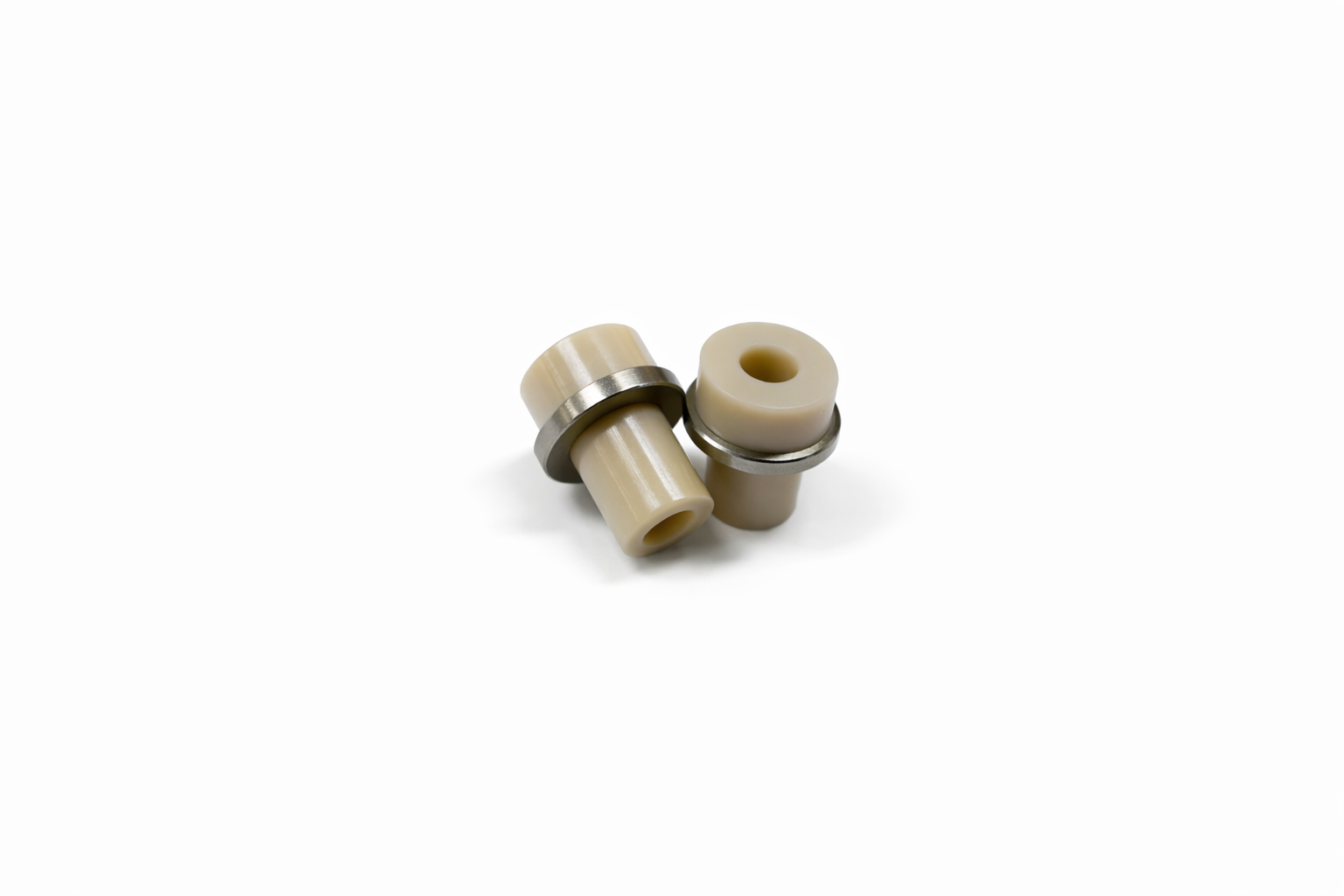
엔지니어링 플라스틱 부품의 기능적 진화와 적용 배경
엔지니어링 플라스틱은 단순한 경량 소재의 범주를 넘어, 기계적 기능을 수행하는 핵심 부품 소재로 자리잡고 있습니다. 특히 회전 및 왕복 운동이 반복되는 구조에서는 금속 대비 낮은 마찰계수와 자기윤활 특성을 기반으로 한 기능성 트라이볼로지 소재로 활용됩니다.
샤프트 내부에 삽입되는 수지링은 대표적인 슬리브 베어링 또는 부싱 구조로 분류되며, 접촉면에서 발생하는 마찰을 줄이고 상대 부품의 손상을 억제하는 역할을 수행합니다. 금속 간 접촉에서 발생하는 스틱-슬립(stick-slip) 현상이나 국부 마모 문제를 완화하는 데 효과적이며, 윤활이 제한된 환경에서도 안정적인 성능을 유지할 수 있습니다.
특히 POM, PTFE, PEEK 계열과 같은 소재는 금속과의 접촉 시에도 낮은 마모율과 안정적인 마찰 특성을 유지하며, 실제 산업 현장에서는 금속 샤프트와의 조합에서 이상적인 마찰 특성을 형성하는 구조로 적용됩니다. 이러한 특성은 장비 수명 연장과 유지보수 비용 절감 측면에서 중요한 설계 요소로 작용합니다.
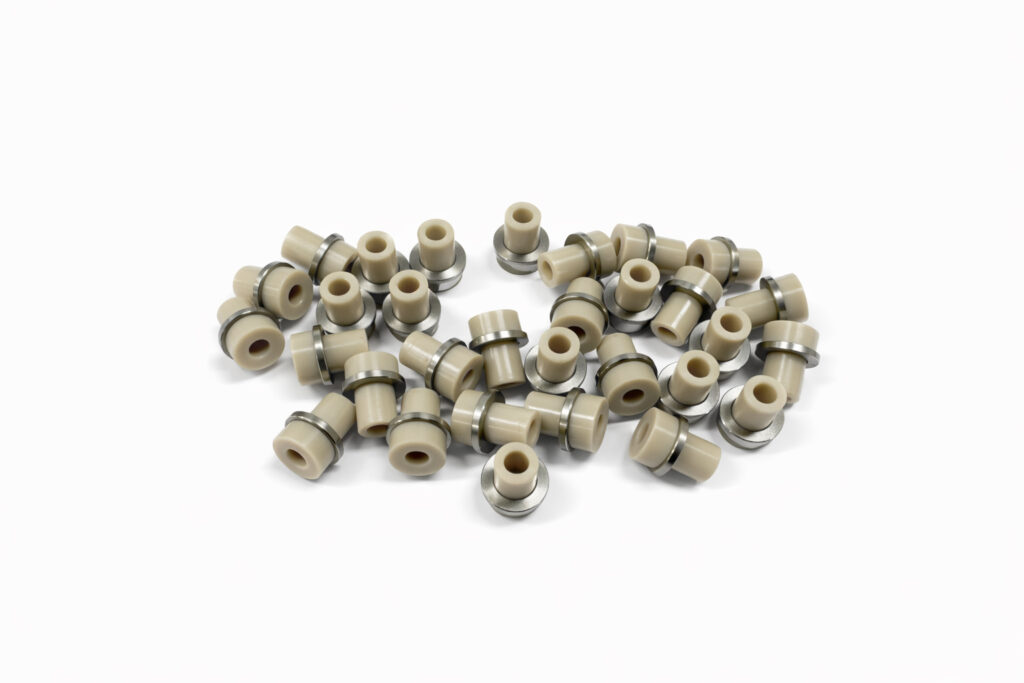
봉재 기반 CNC 가공 방식의 기술적 장점
수지입 부품은 일반적으로 봉재 또는 판재 형태의 원자재에서 출발하며, CNC 선반 및 머시닝 센터를 통해 절삭 가공됩니다. 이 방식은 금형을 필요로 하지 않기 때문에 초기 투자 부담이 없으며, 소량 다품종 생산 환경에서 매우 효율적인 구조를 형성합니다.
사출 성형이 수만 개 이상의 대량 생산에서 가격 경쟁력을 가지는 반면, 수십 개에서 수백 개 단위의 정밀 부품 제작에서는 CNC 가공이 훨씬 현실적인 선택입니다. 특히 개발 단계에서의 설계 변경이나 프로토타입 제작 과정에서는 가공 유연성이 매우 중요하게 작용합니다.
또한 봉재 기반 가공은 소재 내부의 물성 균일성을 확보할 수 있다는 장점이 있습니다. 사출 성형 제품은 금형 내 유동 과정에서 분자 배열 방향성이 형성되며, 이로 인해 방향에 따른 기계적 성질 차이가 발생할 수 있습니다. 반면 봉재 가공 부품은 등방성 특성을 유지하기 때문에 치수 안정성과 반복 정밀도 확보 측면에서 유리한 구조를 갖습니다.
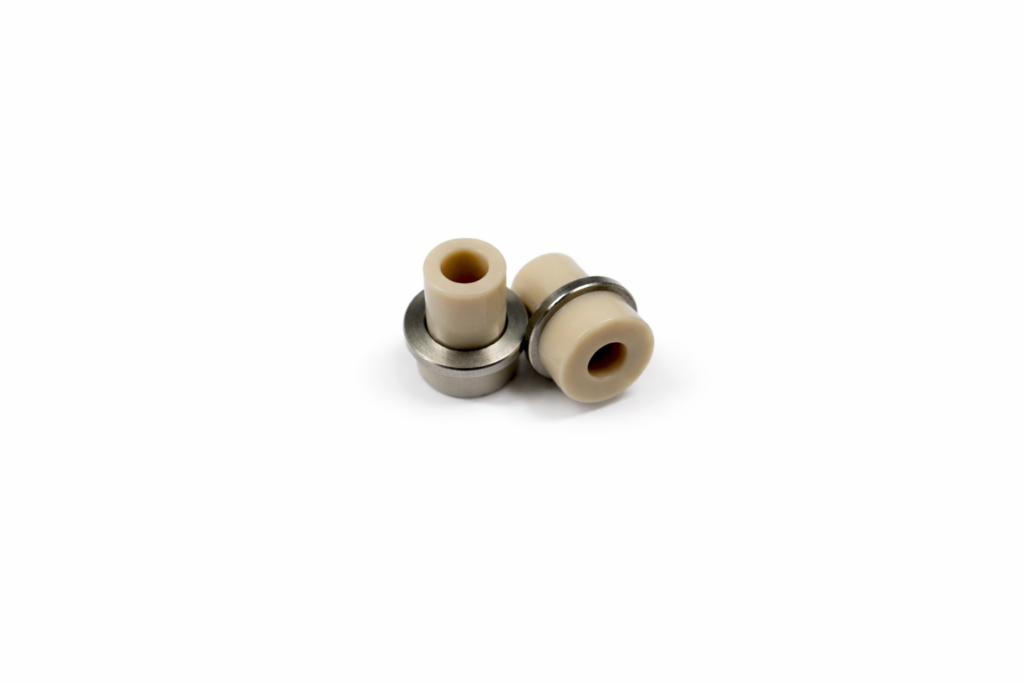
수지 부싱의 마찰 및 마모 제어 메커니즘
수지 부싱은 단순히 마찰을 줄이는 역할을 넘어, 전체 시스템의 내구성과 안정성을 좌우하는 핵심 요소입니다. 샤프트와의 접촉 환경에서는 접촉 압력 상승, 국부적인 마찰열 발생, 그리고 반복 하중에 따른 크리프 변형이 동시에 발생합니다.
이러한 환경에서 엔지니어링 플라스틱은 다음과 같은 물리적 특성을 기반으로 작동합니다. 낮은 마찰계수는 초기 구동 저항을 줄이며, 자기윤활성은 외부 윤활 없이도 안정적인 슬라이딩을 가능하게 합니다. 또한 특정 소재는 표면에 미세한 전이막(transfer film)을 형성하여 마찰을 더욱 감소시키는 특성을 보입니다.
그러나 하중이 증가할수록 플라스틱 단독 구조만으로는 변형 및 마모 문제가 발생할 수 있으며, 이를 보완하기 위한 구조 설계가 필수적으로 요구됩니다.
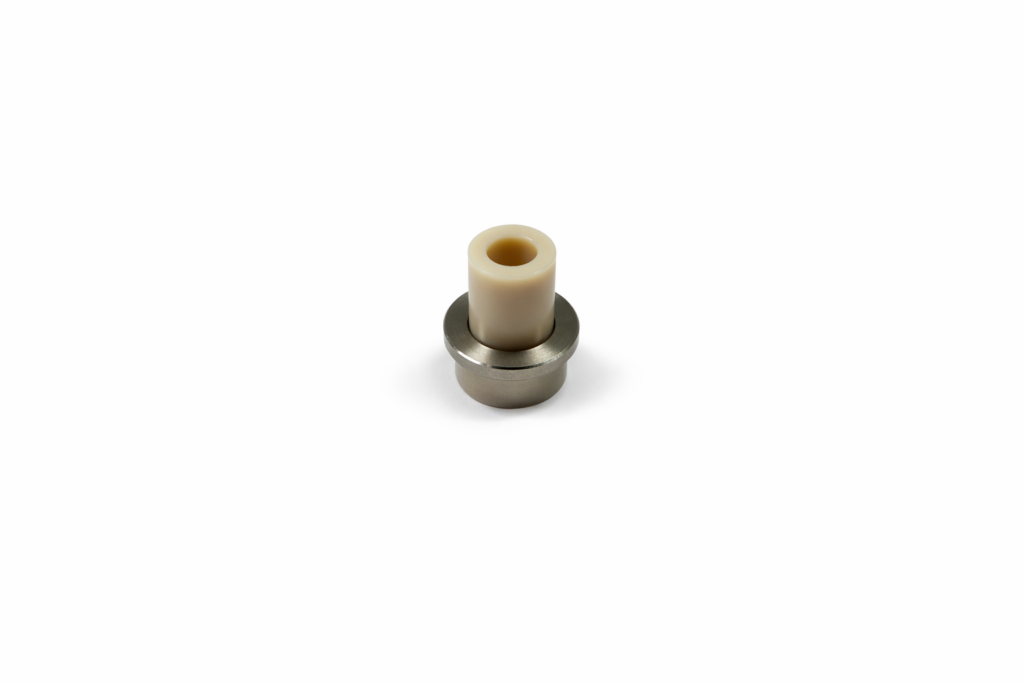
금속 워셔 결합 구조의 설계 의미
수지링 외부 또는 단부에 금속 워셔를 결합하는 구조는 단순한 보강이 아닌 복합 베어링 설계 개념에 해당합니다. 금속과 폴리머를 조합함으로써 서로의 물성을 보완하는 구조가 형성됩니다.
금속은 높은 강성과 열전도성을 기반으로 하중을 지지하고, 플라스틱은 저마찰 및 마모 억제 기능을 수행합니다. 이 두 가지 역할이 결합되면 고하중 조건에서도 안정적인 슬라이딩 성능을 확보할 수 있습니다.
특히 회전 구조에서는 축 방향 하중이 동시에 작용하는 경우가 많으며, 이때 워셔는 하중을 분산시키고 접촉면을 보호하는 역할을 수행합니다. 또한 충격 하중이 발생하는 환경에서는 변형을 억제하고 구조적 안정성을 유지하는 기능도 함께 수행합니다.
이와 같은 복합 구조는 단일 소재로는 구현하기 어려운 성능을 확보할 수 있으며, 고속 회전 장비나 반복 하중이 큰 산업 장비에서 필수적인 설계 요소로 적용됩니다.
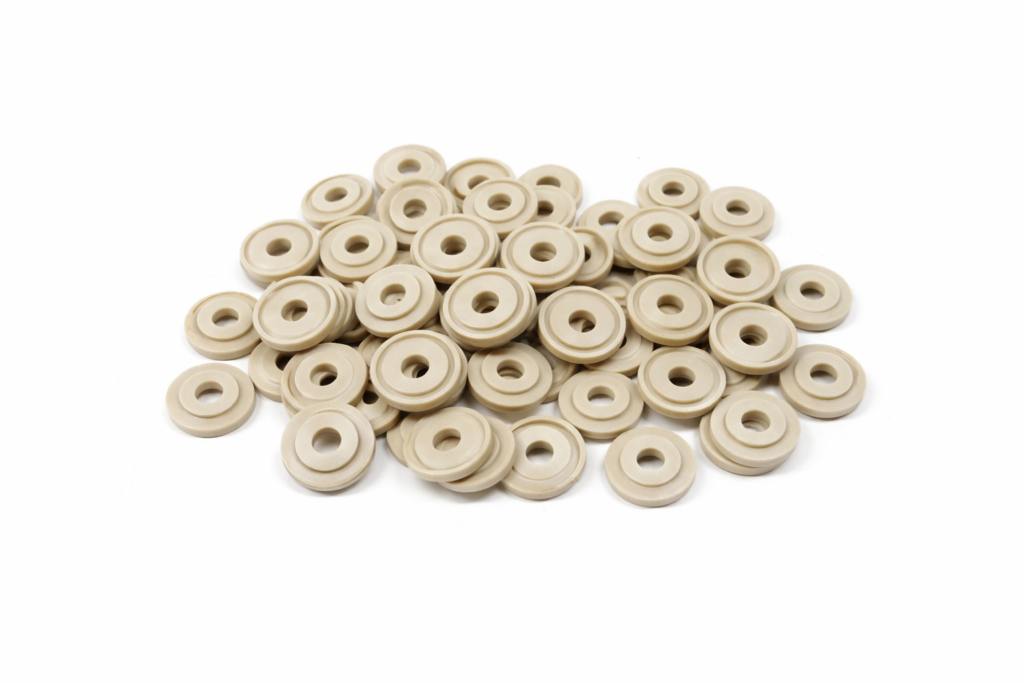
주요 엔지니어링 플라스틱 소재 특성
수지 부품에 사용되는 주요 소재는 각각의 물리적 특성과 적용 환경에 따라 선택됩니다.
Nylon 6과 Nylon 66은 높은 인장강도와 내충격성을 바탕으로 기어 및 부싱류에 널리 사용되며, 비교적 높은 흡습률을 가지기 때문에 환경 조건에 따른 치수 변화 고려가 필요합니다.
POM은 낮은 마찰계수와 우수한 가공성을 갖고 있어 정밀 부싱 및 슬라이딩 부품에 적합하며, 치수 안정성이 뛰어난 소재로 평가됩니다.
PEEK는 고온 환경에서도 기계적 강도를 유지할 수 있는 고성능 소재로, 반도체 및 항공 산업에서 사용되는 고부하 부품에 적용됩니다.
PTFE는 매우 낮은 마찰계수를 가지며 화학적 안정성이 뛰어나지만, 기계적 강도가 낮기 때문에 보강 구조와 함께 사용되는 경우가 많습니다.
UHMW-PE는 충격 흡수 능력과 내마모성이 우수하여 반복 충격 환경에서 사용되며, 라이너나 가이드 부품에 적합한 특성을 보입니다.
이처럼 각 소재는 마찰 특성, 온도 조건, 하중 조건, 그리고 환경적 요소를 종합적으로 고려하여 선택되어야 하며, 단순한 물성 비교를 넘어 실제 사용 조건에 기반한 엔지니어링 판단이 필요합니다.
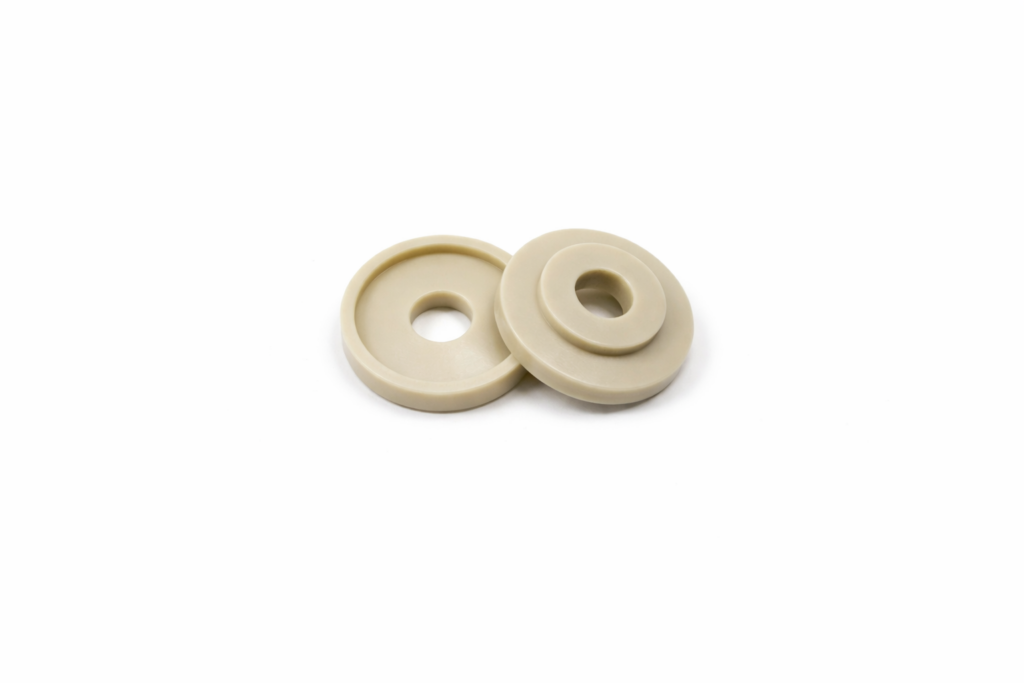
CNC 가공과 사출 성형의 구조적 차이
사출 성형은 대량 생산에 적합한 방식이지만, 정밀 부싱과 같은 기능성 부품에서는 구조적 한계가 존재합니다. 금형 내 유동 과정에서 발생하는 웰드라인, 수축률 불균일, 그리고 냉각 속도 차이에 따른 변형은 정밀도 저하의 주요 원인이 됩니다.
특히 내경과 외경의 동심도 및 진원도가 중요한 부싱류 부품에서는 이러한 문제들이 성능 저하로 직결됩니다.
반면 CNC 가공은 절삭 조건을 정밀하게 제어할 수 있어 미크론 단위의 공차 관리가 가능하며, 표면 조도 또한 매우 낮은 수준으로 구현됩니다. 일반적으로 산업용 부싱에서 요구되는 표면 조도 기준은 Ra 0.8μm 이하이며, CNC 가공에서는 이를 안정적으로 확보할 수 있습니다.
이러한 차이는 실제 사용 환경에서의 마찰 안정성, 소음 감소, 그리고 수명 측면에서 큰 차이를 만들어냅니다.
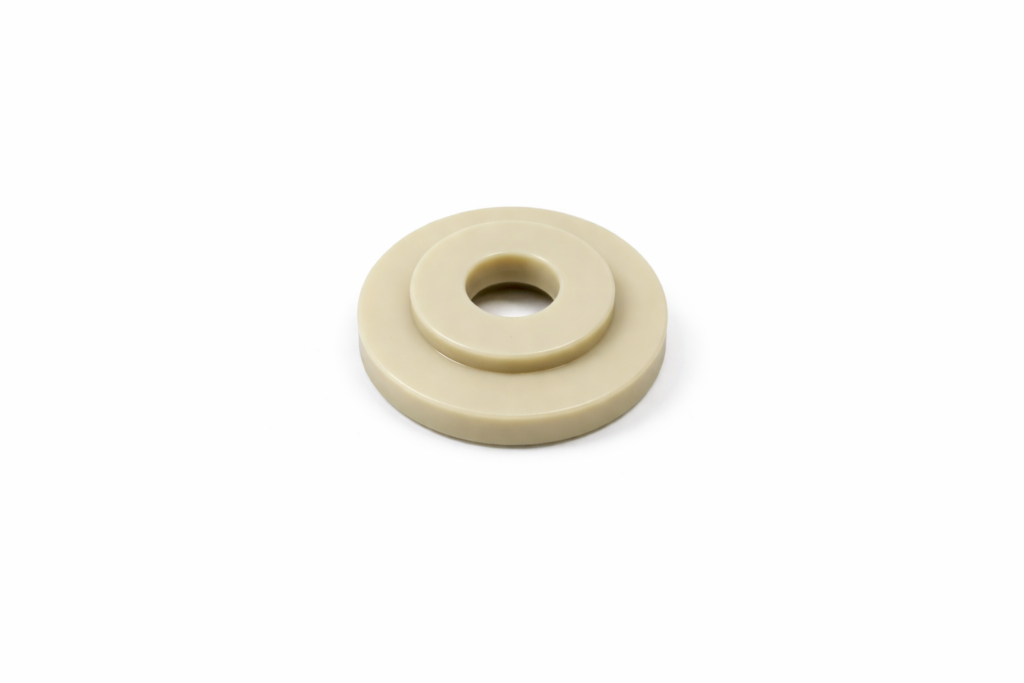
산업 적용 분야와 확장 가능성
CNC 가공 수지링은 다양한 산업 분야에서 핵심 부품으로 활용됩니다. 전자 및 커넥터 내부의 슬라이딩 구조에서는 정밀한 위치 제어와 반복 내구성이 요구되며, 자동차 산업에서는 회전 부품의 마찰 감소와 소음 억제가 중요한 요소로 작용합니다.
의료기기에서는 윤활이 제한된 환경에서도 안정적인 작동이 필요하며, 반도체 장비에서는 오염을 최소화하는 무윤활 구조가 필수적으로 요구됩니다.
이러한 환경에서는 금속 기반 베어링보다 플라스틱 기반 구조가 더 적합한 경우가 많으며, 특히 유지보수 비용 절감과 장비 신뢰성 확보 측면에서 중요한 역할을 합니다.
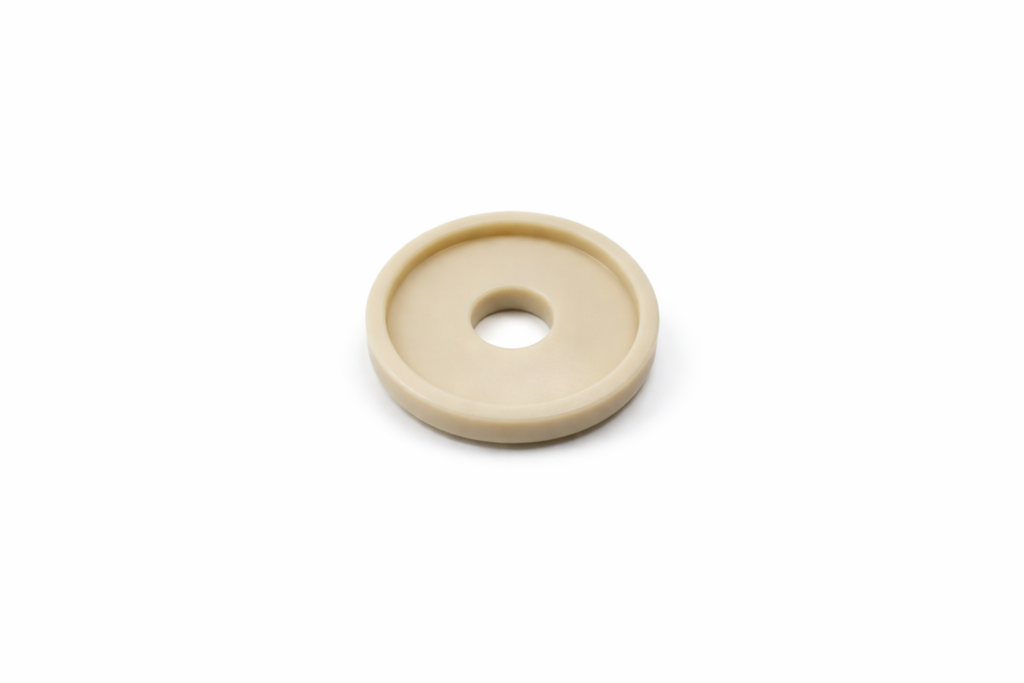
복합 설계 기반 정밀 수지 부품의 완성도
수지입 CNC 가공 부품의 성능은 단일 요소로 결정되지 않습니다. 소재 선택, 공차 설계, 가공 조건, 그리고 부가 구조물과의 결합 설계가 하나의 시스템으로 통합되어야 최적의 성능이 구현됩니다.
플랜지 일체형 구조에서는 접촉 면적을 넓혀 하중을 분산시키며, 보스 높이와 플랜지 두께의 비율은 강성과 유연성의 균형을 결정하는 핵심 설계 변수로 작용합니다.
또한 반복 하중 환경에서는 PV값, 즉 압력과 속도의 곱으로 정의되는 조건을 기준으로 소재의 사용 한계를 설정해야 하며, 이를 초과할 경우 마모 및 변형이 급격히 증가할 수 있습니다.
결과적으로 CNC 가공 수지 부품은 단순한 절삭 가공 결과물이 아니라, 사용 환경 전체를 고려한 통합 엔지니어링 설계의 결과물로 정의됩니다. 이러한 접근 방식이 적용될 때 고정밀, 고내구성, 그리고 장기적인 안정성을 동시에 확보할 수 있습니다.
Precision CNC Machining of Engineering Plastic Bushings and Resin Rings for High-Performance Applications
Functional Evolution of Engineering Plastics in Mechanical Components
Engineering plastics have evolved beyond lightweight alternatives into critical functional materials used in mechanical systems. In applications involving rotational or reciprocating motion, these materials serve as key tribological elements due to their low friction coefficient and self-lubricating properties.
Resin rings inserted into shafts are typically classified as sleeve bearings or bushings. Their primary function is to reduce friction between contact surfaces while protecting mating components from wear and damage. Compared to metal-to-metal contact, plastic-based interfaces significantly reduce stick-slip behavior and localized wear, enabling stable operation even in lubrication-limited environments.
Materials such as POM, PTFE, and PEEK exhibit excellent wear resistance when paired with metal shafts. These combinations form stable tribological systems, contributing to extended component life and reduced maintenance requirements in industrial equipment.
Advantages of CNC Machining from Rod Stock
Engineering plastic components are commonly manufactured from rod stock or plate stock using CNC turning and milling processes. This approach eliminates the need for molds, making it highly suitable for low-volume and high-mix production environments.
While injection molding is cost-effective for mass production, CNC machining offers superior flexibility for small batch production and prototyping. Design modifications can be implemented quickly without additional tooling costs, making it ideal for development and custom applications.
Another significant advantage of rod-based machining is material uniformity. Injection molded parts often develop molecular orientation during the flow process, leading to anisotropic properties. In contrast, machined components maintain isotropic material characteristics, ensuring consistent mechanical performance and dimensional stability.
Friction and Wear Control Mechanism in Plastic Bushings
Plastic bushings play a critical role in controlling friction and wear within mechanical systems. In shaft applications, components are subjected to increasing contact pressure, localized heat generation, and repetitive loading cycles that can lead to creep deformation.
Engineering plastics address these challenges through inherent material properties. Their low friction coefficient reduces initial resistance, while self-lubricating behavior allows stable operation without external lubrication. Some materials also form transfer films on contact surfaces, further enhancing wear resistance.
However, under high-load conditions, plastic-only designs may experience deformation or accelerated wear. This limitation necessitates the integration of additional structural elements to improve performance and durability.
Engineering Significance of Metal Washer Integration
The integration of metal washers with plastic bushings represents a composite bearing design approach rather than simple reinforcement. This structure combines the strengths of both materials to achieve optimized performance.
Metal components provide load-bearing capacity and thermal conductivity, while plastic elements contribute low friction and wear resistance. This combination enables simultaneous achievement of high load capacity and smooth sliding performance.
In rotating systems, axial loads are often present alongside radial loads. Metal washers help distribute these loads, protect contact surfaces, and reduce localized stress concentrations. They also provide impact resistance and limit deformation under dynamic conditions.
Such hybrid structures are widely used in high-speed and high-load applications where single-material solutions are insufficient.
Characteristics of Major Engineering Plastic Materials
Different engineering plastics are selected based on application requirements, including load conditions, temperature range, and environmental factors.
Nylon 6 and Nylon 66 offer high tensile strength and impact resistance, making them suitable for gears and bushings. However, their relatively high moisture absorption requires consideration of dimensional changes in humid environments.
POM provides excellent machinability, low friction, and high dimensional stability, making it ideal for precision bushings and sliding components.
PEEK maintains mechanical strength at elevated temperatures and is commonly used in semiconductor, aerospace, and high-performance industrial applications.
PTFE offers extremely low friction and outstanding chemical resistance, but its low mechanical strength often requires reinforcement in structural applications.
UHMW-PE is known for its superior impact resistance and wear properties, making it suitable for liners and components exposed to repetitive impact.
Material selection must be based on a comprehensive evaluation of operating conditions rather than simple property comparison.
Structural Differences Between CNC Machining and Injection Molding
Injection molding is advantageous for large-scale production, but it presents inherent limitations in precision applications. Issues such as weld lines, uneven shrinkage, and warpage can compromise dimensional accuracy.
These limitations are particularly critical in bushing components, where roundness and concentricity directly affect performance.
CNC machining, on the other hand, enables precise control of cutting parameters, allowing micron-level tolerances and superior surface finishes. Surface roughness values below Ra 0.8 μm are consistently achievable, which is essential for stable sliding performance and reduced wear.
This level of precision directly impacts operational stability, noise reduction, and component lifespan.
Industrial Applications of CNC Machined Resin Rings
CNC machined plastic bushings are widely used across various industries. In electronic connectors, they provide precise sliding mechanisms. In automotive systems, they reduce friction and noise in rotating components.
Medical devices require reliable operation in lubrication-restricted environments, while semiconductor equipment demands contamination-free, dry-running systems.
In such applications, plastic-based bearing solutions often outperform traditional metal components, particularly in terms of maintenance reduction and operational reliability.
Integrated Design Approach for High-Precision Plastic Components
The performance of CNC machined plastic components is not determined by a single factor. It is the result of an integrated engineering approach that combines material selection, tolerance design, machining conditions, and structural integration.
Flanged designs increase contact area to distribute loads more effectively, while the ratio between flange thickness and boss height determines the balance between stiffness and flexibility.
In repetitive load conditions, wear performance is evaluated using the PV value, defined as the product of pressure and velocity. Operating within the allowable PV range is essential to prevent excessive wear and deformation.
Ultimately, CNC machined engineering plastic components are not simply machined parts but engineered systems optimized for their operating environment. This approach ensures high precision, durability, and long-term performance stability.
추가 정보
수지입 CNC 가공은 저마찰, 내마모, 치수 안정성이 요구되는 정밀 부싱 및 수지링 제작에 적용되는 핵심 가공 방식입니다. 특히 샤프트 내부 삽입 구조에서는 단순 소재 선택을 넘어 공차, 표면조도, 하중 분산 구조까지 함께 설계되어야 안정적인 성능을 확보할 수 있습니다.
엔지니어링 플라스틱 부품은 사출이 아닌 CNC 가공을 통해 높은 정밀도와 반복 재현성을 확보할 수 있으며, 소량 정밀 부품 및 커스텀 설계에서 효과적인 선택지가 됩니다.
핵심 포인트 정리
- 수지입 CNC 가공은 정밀 부싱 및 슬리브 베어링 구조에 적합합니다
- POM, PEEK, PTFE 등은 저마찰 특성을 기반으로 트라이볼로지 성능이 우수합니다
- 봉재 가공은 등방성 확보로 치수 안정성이 뛰어납니다
- 내경 진원도 및 표면 조도는 부품 성능에 직접적인 영향을 미칩니다
- 금속 워셔 결합은 축 방향 하중 분산에 효과적입니다
- CNC 가공은 소량 생산 및 설계 변경 대응에 유리합니다
- 사출 대비 정밀 공차 구현이 용이합니다
자주 묻는 질문 (FAQ)
수지입 CNC 가공이란 무엇인가요?
수지입 CNC 가공은 엔지니어링 플라스틱 소재를 절삭 가공하여 정밀 부품으로 제작하는 방식입니다. 특히 부싱, 수지링, 슬리브 형태 부품에 적용되며 높은 정밀도가 요구되는 환경에서 사용됩니다.
수지 부싱은 금속 베어링을 대체할 수 있나요?
저하중 또는 윤활이 제한된 환경에서는 충분히 대체가 가능합니다. 특히 저마찰, 무윤활 구조가 필요한 장비에서는 플라스틱 부싱이 더 적합한 경우도 많습니다.
POM과 PEEK 중 어떤 소재가 더 좋은가요?
POM은 정밀도와 가공성이 우수하며 일반 산업용에 적합합니다. PEEK는 고온 및 고하중 환경에 적합한 고성능 소재로, 사용 조건에 따라 선택이 달라집니다.
사출 성형 대신 CNC 가공을 선택하는 이유는 무엇인가요?
소량 생산, 정밀 공차, 빠른 설계 변경 대응이 필요한 경우 CNC 가공이 더 유리합니다. 사출은 대량 생산에는 적합하지만 정밀도에서는 한계가 존재합니다.
워셔를 추가하는 이유는 무엇인가요?
워셔는 축 방향 하중을 분산시키고 마찰면을 보호하는 역할을 합니다. 특히 반복 하중 환경에서 수지 변형과 마모를 줄이는 데 효과적입니다.
수지 부품의 마모는 어떻게 관리하나요?
적절한 소재 선택과 함께 PV값(압력×속도)을 기준으로 설계해야 합니다. 또한 표면 조도와 하중 분포 설계가 중요하게 작용합니다.
수지입 가공에서 가장 중요한 요소는 무엇인가요?
소재, 공차, 가공 조건, 그리고 사용 환경을 종합적으로 고려하는 것이 중요합니다. 단순 가공이 아닌 설계 기반 접근이 필요합니다.
기술 확장 설명
정밀 공차와 치수 안정성
수지입 CNC 가공에서는 내경 공차와 진원도가 핵심 변수로 작용합니다. 특히 샤프트와의 결합 구조에서는 미세한 오차가 마찰 증가 및 소음으로 이어질 수 있습니다.
봉재 가공은 이러한 정밀 요구 조건에서 안정적인 결과를 제공하며 반복 생산에서도 일관성을 유지합니다.
표면 조도와 마찰 특성
표면 조도는 단순 외관 요소가 아니라 마찰 특성과 직결되는 요소입니다. Ra 값이 높을수록 마찰열과 마모가 증가할 수 있으며, 적절한 가공 조건이 필수적입니다.
복합 베어링 구조 설계
금속과 플라스틱을 결합한 구조는 각각의 장점을 극대화하는 방식입니다. 금속은 하중을 지지하고 플라스틱은 마찰을 줄이는 역할을 수행합니다.
관련 기술 정보
정밀 가공 및 다양한 제조 공정에 대한 추가 내용은 인사이트에서 확인할 수 있습니다.
CNC 정밀가공 부품, 정밀프레스가공 부품, 구조연결용 부품 등과 함께 비교 검토가 가능합니다.
전기적 접촉 구조는 전기접점, 배선 구조는 케이블와이어 하네스에서 확인할 수 있습니다.
금속 접합 공정 관련 내용은 브레이징 및 금속접합소재 페이지를 참고할 수 있습니다.