
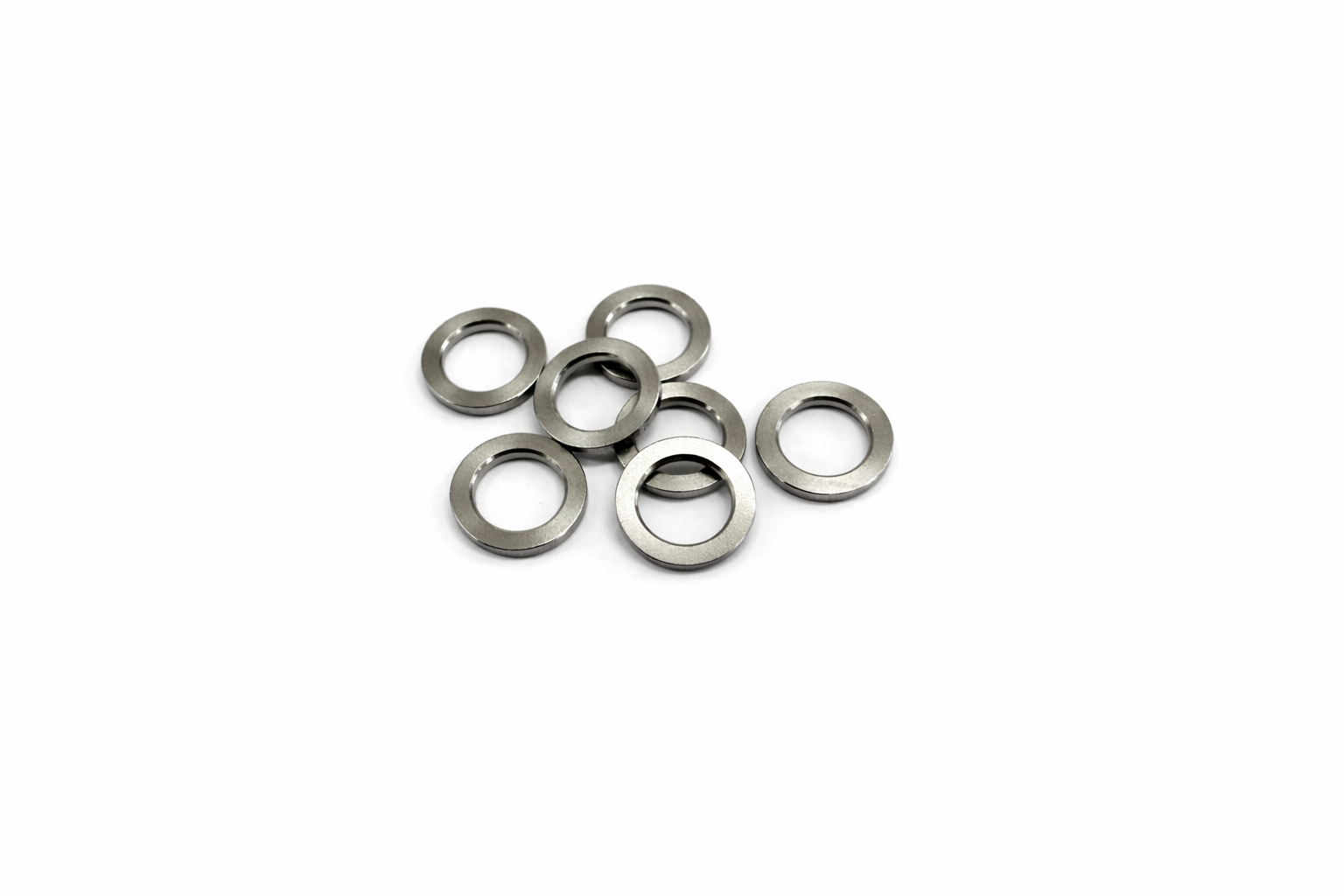
초정밀 체결 CNC 가공 워셔 정밀 부품
산업 기계와 정밀 장비에서 사용되는 워셔는 단순한 간격 조정 부품이 아니라 체결 하중을 안정적으로 분산시키고 장기간 체결 안정성을 유지하는 핵심 기계 요소입니다. 볼트와 너트 사이에 삽입되는 워셔는 접촉 면적을 넓혀 체결 압력을 균일하게 전달하며, 반복 진동이나 열 변화로 인한 풀림 현상을 완화하는 역할을 합니다.
과거에는 이러한 워셔가 대부분 프레스 스탬핑 방식으로 생산되었습니다. 이 방식은 대량 생산에 매우 유리하지만, 최근 산업 구조가 변화하면서 요구되는 정밀도 수준이 크게 높아졌습니다. 의료 장비, 항공우주 시스템, 반도체 장비, 정밀 자동화 장비와 같은 분야에서는 마이크론 단위의 오차 관리가 요구되며, 이러한 환경에서는 기존 금형 방식의 한계가 명확하게 드러납니다.
이러한 배경 속에서 CNC(Computer Numerical Control) 절삭 가공을 활용한 정밀 워셔 제조 기술이 새로운 제조 패러다임으로 자리 잡고 있습니다. CNC 가공은 수치 제어 기반의 절삭 공정을 통해 소재의 형상과 치수를 정밀하게 제어하며, 기존 전단 가공 방식이 가지는 구조적 한계를 극복하는 기술적 대안으로 활용되고 있습니다.
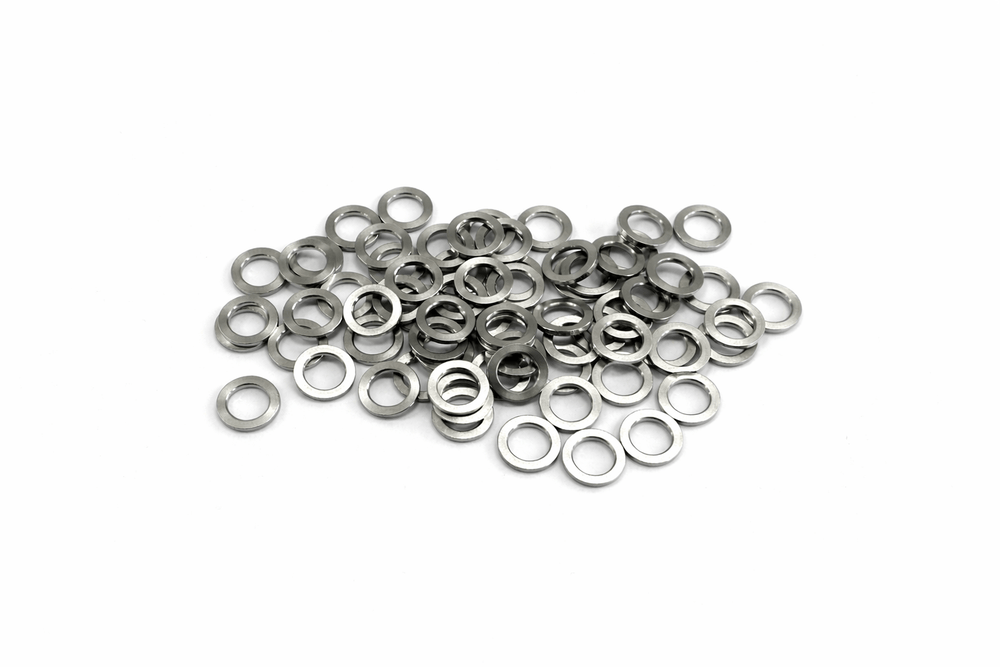
프레스 스탬핑과 CNC 절삭 가공의 물리적 변형 차이
전통적인 프레스 가공은 강력한 압력으로 소재를 찍어 누르는 전단(Shearing) 공정에 의존합니다. 이 과정에서 금속 소재의 단면은 매끄럽게 잘린 전단면과 거칠게 뜯겨 나간 파단면으로 명확히 나뉘게 되며, 공구의 진입 방향에 따라 한쪽으로 금속이 밀려 나오는 버(Burr)나 처짐(Rollover) 현상이 필연적으로 발생합니다. 이러한 구조적 불균형은 워셔의 앞면과 뒷면의 형상을 미세하게 다르게 만들어 고정밀 체결 시 접촉 면적의 불일치를 초래하고, 결과적으로 압력 분포의 불균형을 유발하게 됩니다. 반면 CNC 가공은 동일한 절삭 공구를 사용하여 양면을 순차적으로 가공하거나 동시 가공을 진행하기 때문에 전단 가공 특유의 단면 불연속성이 존재하지 않습니다. 결과적으로 CNC로 제작된 워셔는 전면과 후면이 완벽한 대칭성을 유지하며, 육안으로는 가공 방향을 식별하기 어려울 정도로 균일하고 매끄러운 품질을 확보할 수 있습니다.
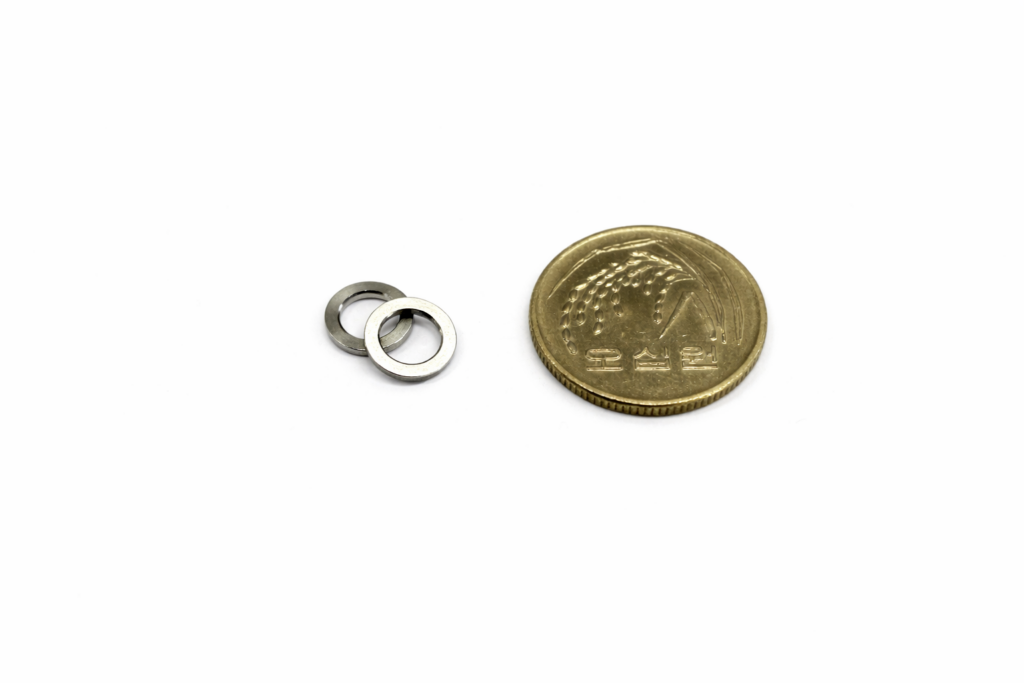
기계적 체결 요소로서 워셔의 기능과 역할
워셔는 체결 시스템에서 하중 전달 구조를 안정화시키는 역할을 수행합니다. 볼트나 너트가 직접 접촉하는 경우 체결 하중이 국부적으로 집중될 수 있는데, 워셔는 이러한 집중 하중을 넓은 면적으로 분산시키는 기능을 수행합니다.
또한 워셔는 다음과 같은 기능적 역할을 담당합니다.
• 체결 하중의 균일한 분산
• 체결부 표면 손상 방지
• 진동 환경에서의 체결 안정성 유지
• 체결면 마찰 특성 조절
• 열 팽창 환경에서의 체결 보조
정밀 산업 분야에서는 워셔의 단순한 존재 여부보다 워셔의 평탄도, 표면 조도, 두께 균일성, 그리고 내·외경 공차가 전체 체결 시스템의 성능에 직접적인 영향을 미칩니다. 이러한 이유로 워셔 제조 기술 역시 단순한 판금 공정을 넘어 정밀 기계 가공 영역으로 발전하고 있습니다.
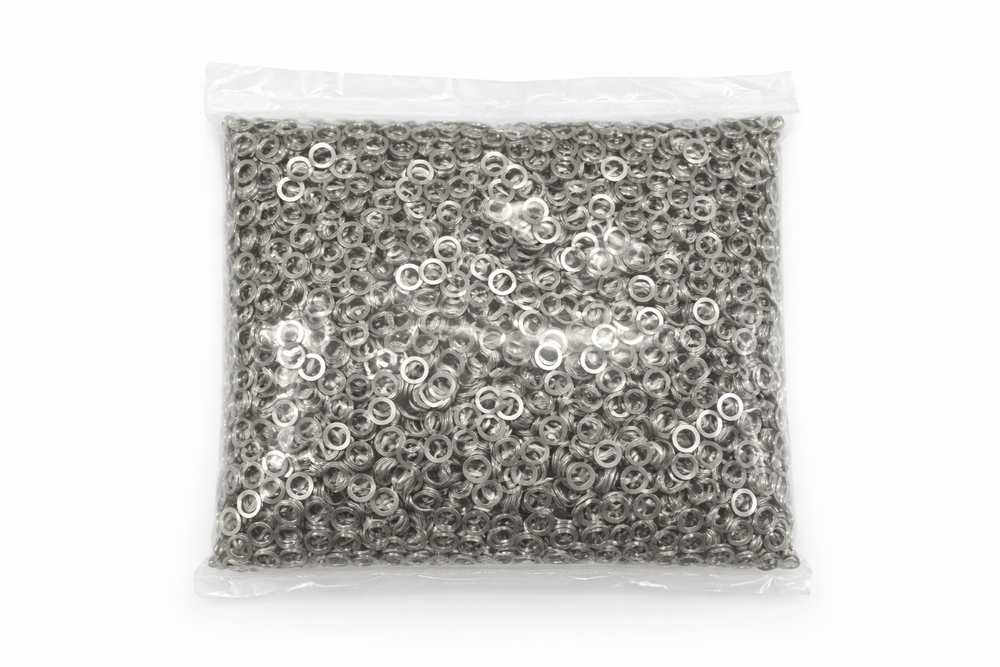
CNC 절삭 가공 워셔의 구조적 정밀성
CNC 가공 방식은 전단이 아닌 절삭 가공(Cutting Machining) 을 기반으로 합니다. 회전하는 소재 또는 공구의 정밀한 움직임을 통해 불필요한 소재를 제거하면서 원하는 형상을 만들어냅니다.
이 공정의 가장 큰 특징은 가공이 수치 제어 프로그램에 의해 수행된다는 점입니다. CAD 설계를 기반으로 CAM 프로그램이 공구 경로를 생성하며, CNC 장비는 이 데이터를 통해 미세한 단위까지 정밀하게 움직입니다.
그 결과 CNC 워셔는 다음과 같은 특성을 갖습니다.
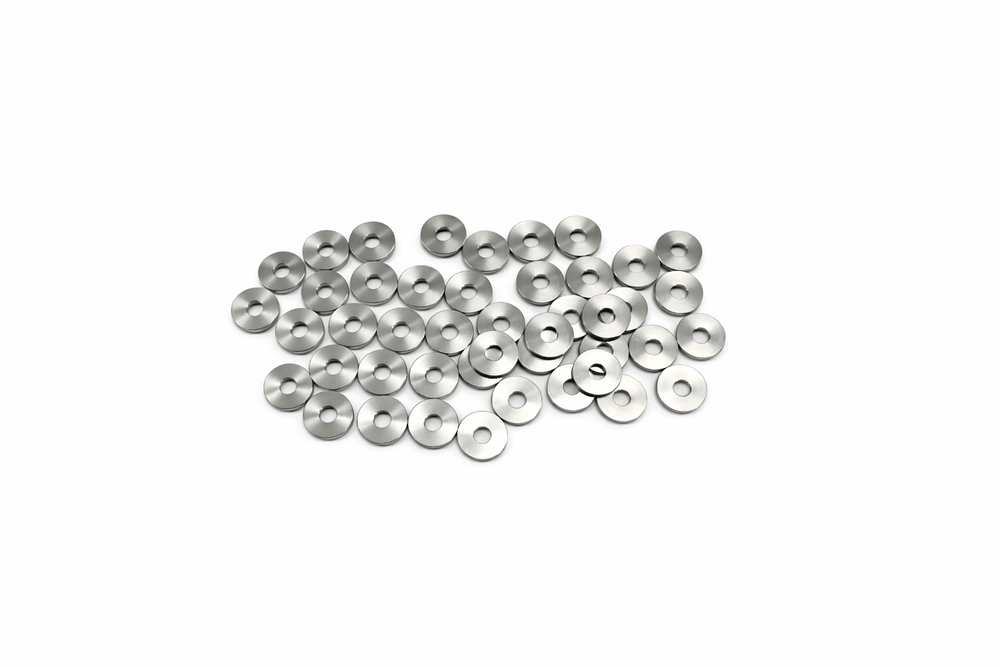
• 앞뒤면이 완전히 동일한 대칭 구조
• 전단면과 파단면이 존재하지 않는 균일한 절삭면
• 버가 거의 발생하지 않는 매끄러운 에지
• 균일한 두께와 평탄도 유지
CNC 공정에서는 워셔의 양면이 동일한 절삭 공정으로 가공되기 때문에 전단 가공에서 발생하는 단면 불균형이 존재하지 않습니다. 결과적으로 워셔의 앞면과 뒷면을 구분할 필요가 없는 완전 대칭 구조가 구현됩니다.
이러한 특성은 자동화 조립 라인에서도 중요한 장점으로 작용합니다. 부품 방향성이 존재하지 않기 때문에 자동 공급 장치에서의 오삽입 가능성이 크게 줄어듭니다.
기하 공차(GD&T) 관점에서의 정밀도 차이
정밀 기계 설계에서는 단순한 치수 정확도뿐 아니라 기하 공차 관리가 매우 중요합니다. 대표적인 기하 공차 요소로는 다음과 같은 항목이 있습니다.
• 평면도(Flatness)
• 평행도(Parallelism)
• 동심도(Concentricity)
• 원통도(Cylindricity)
프레스 가공 워셔의 경우 강한 압력으로 소재를 변형시키는 과정에서 미세한 휨 현상이 발생할 수 있습니다. 특히 얇은 판재에서는 워핑(Warping) 현상이 나타날 가능성이 있습니다.
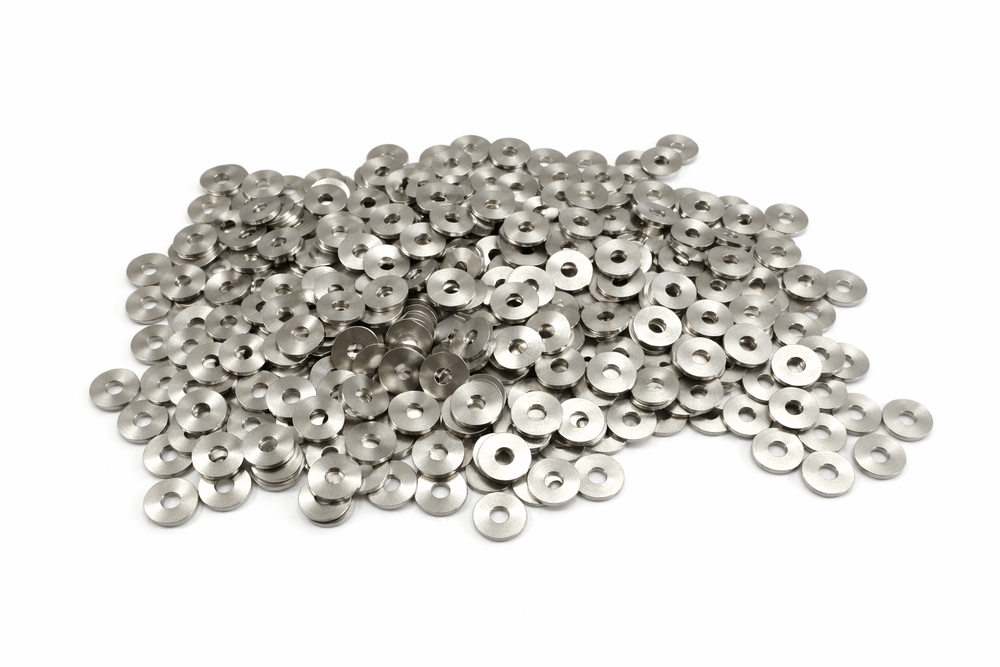
반면 CNC 가공은 절삭 공정을 통해 소재를 점진적으로 제거하기 때문에 이러한 변형이 거의 발생하지 않습니다. 정밀 가공 환경에서는 두께 공차가 약 ±0.005~0.01mm 수준까지 제어되는 경우도 있으며, 내경과 외경 공차 역시 매우 안정적으로 유지됩니다.
이러한 정밀도는 체결 시스템에서 다음과 같은 효과를 제공합니다.
• 체결 하중의 균일한 전달
• 접촉 면적의 최대화
• 마찰 조건의 안정화
• 체결 토크 재현성 향상
결과적으로 체결 시스템 전체의 신뢰성이 향상됩니다.
표면 거칠기와 접촉 특성
워셔의 표면 거칠기는 체결 성능과 직접적으로 연결됩니다. 표면이 거칠면 체결 초기에는 접촉 면적이 제한적이며, 체결 하중이 증가하면서 미세한 표면 돌기들이 눌리면서 임베드먼트 릴렉세이션(Embedment Relaxation)이 발생할 수 있습니다.
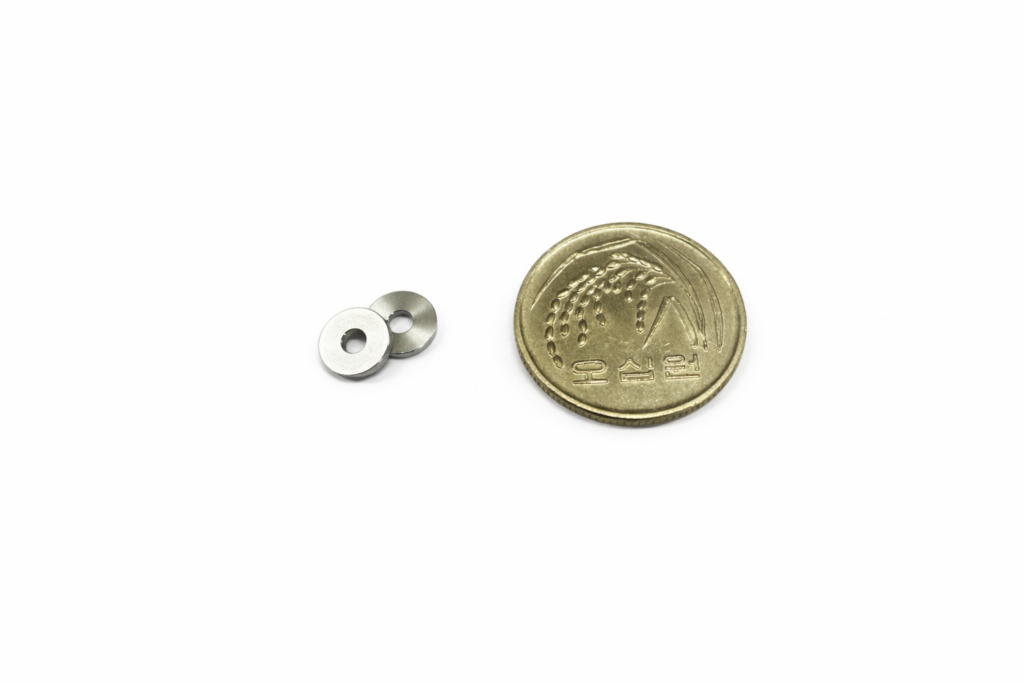
CNC 가공 워셔는 절삭 공정 특성상 매우 균일한 표면 조도를 확보할 수 있습니다. 일반적으로 추가 연마 공정 없이도 비교적 낮은 표면 거칠기 값을 얻을 수 있으며, 필요에 따라 미세 연마나 래핑 공정을 통해 더욱 높은 표면 품질을 구현할 수 있습니다.
이러한 표면 특성은 다음과 같은 산업 환경에서 특히 중요합니다.
• 진공 장비 체결 구조
• 고압 유압 시스템
• 정밀 베어링 장착 구조
• 반도체 장비 체결부
소재 조직 안정성과 내부 응력
프레스 가공은 금속 소재를 순간적으로 변형시키는 소성 가공 방식입니다. 이 과정에서 금속 내부의 결정 구조가 변형되며, 잔류 응력이 형성될 수 있습니다.
잔류 응력은 장기간 사용 환경에서 다음과 같은 문제를 유발할 수 있습니다.
• 장기 변형 가능성
• 열 변화 환경에서의 치수 변화
• 체결 안정성 저하
CNC 절삭 가공은 소재를 점진적으로 제거하는 방식이기 때문에 이러한 내부 응력 형성이 상대적으로 적습니다. 또한 절삭 공정에서는 다양한 합금 소재를 유연하게 가공할 수 있습니다.
대표적으로 다음과 같은 소재들이 CNC 워셔 가공에 사용됩니다.
• 스테인리스강
• 공구강
• 티타늄 합금
• 인코넬 계열 초내열 합금
• 알루미늄 합금
특히 항공우주 및 에너지 산업에서는 티타늄 및 니켈 기반 초합금 워셔가 사용되는 경우가 많으며, 이러한 소재는 프레스 가공이 사실상 어렵기 때문에 CNC 가공이 필수적인 공정으로 활용됩니다.
소량 다품종 생산 환경에서의 제조 유연성
프레스 스탬핑 방식은 금형 제작 비용이 상당히 높은 편입니다. 금형 설계와 제작에는 전문적인 공정이 필요하며 제작 기간도 길어질 수 있습니다.
대량 생산에서는 이러한 초기 비용이 분산되기 때문에 경제성이 확보되지만, 소량 생산이나 시제품 제작에서는 부담이 될 수 있습니다.
CNC 가공 방식은 이러한 문제를 해결합니다. CAD 설계 데이터를 기반으로 CAM 프로그램을 생성한 후 바로 가공이 가능하기 때문에 금형 제작 과정이 필요하지 않습니다.
이로 인해 다음과 같은 장점이 발생합니다.
• 시제품 제작 속도 향상
• 설계 변경 대응 용이
• 소량 생산 비용 절감
• 다양한 형상 제작 가능
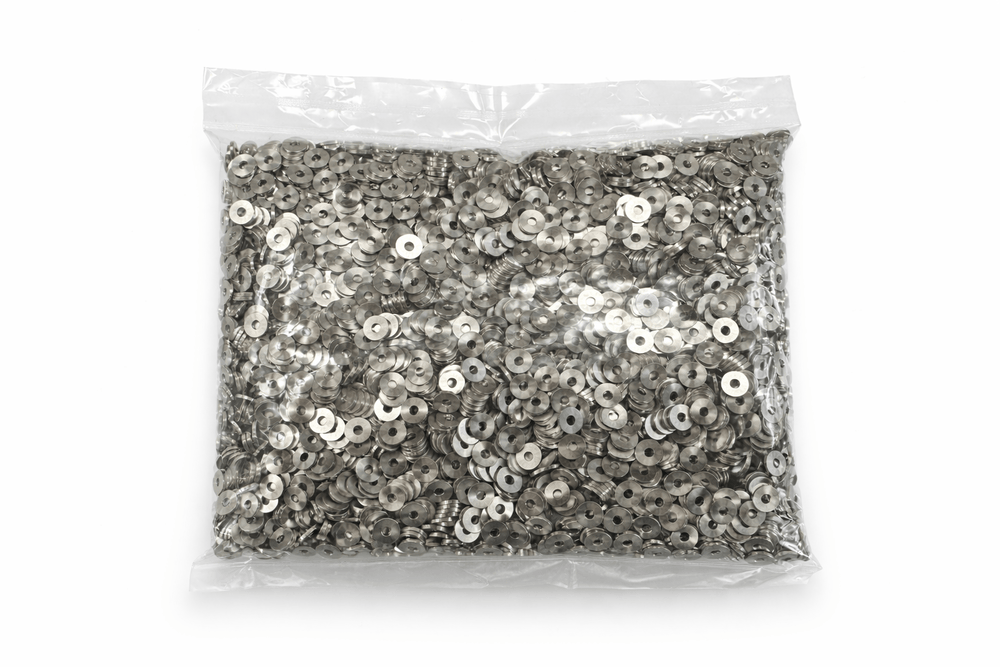
특히 연구 장비나 특수 산업 장비에서는 50개에서 수천 개 수준의 생산량이 일반적이며, 이러한 환경에서는 CNC 가공이 매우 효율적인 제조 방식으로 평가됩니다.
산업 분야에서 CNC 워셔의 적용 확대
정밀 워셔는 다양한 산업 분야에서 활용되고 있습니다.
자동차 파워트레인 분야에서는 정밀 워셔가 체결 하중을 안정적으로 분산시키면서 진동 환경에서도 토크 유지율을 향상시키는 역할을 합니다. 이는 엔진 구성 부품의 장기 내구성을 높이는 요소로 작용합니다.
항공우주 산업에서는 경량 구조 설계와 극한 환경 대응이 중요합니다. 티타늄 합금 워셔는 높은 강도 대비 낮은 밀도를 가지며, 극한 온도 환경에서도 안정적인 기계적 특성을 유지합니다.
반도체 장비 산업에서는 초정밀 체결 구조가 요구됩니다. 미세 진동이나 열 변형이 장비 성능에 직접적인 영향을 미치기 때문에 체결 부품의 정밀도가 매우 중요합니다.
전자기기 조립 환경에서는 두께 0.1mm 이하의 초박형 워셔가 사용되는 경우도 있습니다. 이러한 부품은 공간 제약이 큰 전자 장비 내부에서 체결 안정성을 유지하는 역할을 수행합니다.
중장비 및 산업 설비 분야에서는 스텝드 워셔나 특수 형상의 워셔를 통해 미스얼라인먼트를 보정하거나 베어링 장착 구조를 안정화시키는 설계가 적용됩니다.
정밀 공학에서 워셔 제조 기술
정밀 기계 시스템에서는 작은 부품 하나가 전체 시스템의 신뢰성에 영향을 미칠 수 있습니다. 워셔는 외형적으로 단순한 부품이지만, 체결 구조에서 매우 중요한 역할을 담당합니다.
대량 생산 환경에서는 프레스 방식이 여전히 높은 효율성을 제공합니다. 그러나 초정밀 체결이 요구되는 산업 영역에서는 CNC 절삭 가공 워셔가 가지는 정밀도와 대칭성이 중요한 기술적 가치로 평가됩니다.
특히 완전 대칭 구조의 워셔는 조립 방향성을 제거하여 자동화 생산 공정에서도 안정적인 조립 품질을 유지할 수 있습니다. 또한 높은 평탄도와 균일한 표면 품질은 체결 하중을 균등하게 분산시키는 역할을 합니다.
결국 제조 공정의 선택은 부품이 사용되는 환경의 요구 수준에 의해 결정됩니다. 극한의 정밀도가 요구되는 산업 분야일수록 CNC 가공 워셔가 제공하는 구조적 정밀성과 기계적 안정성이 전체 시스템 품질을 결정하는 핵심 요소로 작용합니다.
CNC Machined Precision Washer Manufacturing Process for Mechanical Fastening Components
Precision washers used in industrial machinery and high-accuracy equipment are not merely simple spacing components. They are critical mechanical elements that distribute fastening loads and maintain long-term joint stability. Installed between bolts and nuts, washers increase the contact area, allowing clamping pressure to be transmitted evenly while reducing the risk of loosening caused by vibration or thermal variation.
Historically, most washers were produced through press stamping processes. This manufacturing approach is highly efficient for mass production; however, modern industrial environments demand significantly higher levels of dimensional precision. Sectors such as medical devices, aerospace systems, semiconductor equipment, and high-precision automation machinery require dimensional control at the micron level. Under these conditions, the structural limitations of conventional stamping processes become increasingly evident.
Within this context, precision washer manufacturing using CNC (Computer Numerical Control) machining has emerged as a modern production standard. CNC machining employs numerically controlled cutting processes that allow precise control of geometry and dimensional tolerances, providing a technological alternative that overcomes the inherent limitations of shear-based manufacturing methods.
Physical Deformation Differences Between Press Stamping and CNC Cutting
Traditional press stamping relies on a shearing process in which metal sheets are cut using high compressive force. During this operation, the cross-section of the metal typically divides into two distinct regions: a smooth sheared surface and a fractured surface where the material separates irregularly.
Due to the directional nature of the tool entry, metal is displaced during the cutting process, inevitably producing burr formation and rollover deformation. This structural asymmetry results in subtle differences between the front and back surfaces of the washer.
Such irregularities can lead to slight inconsistencies in contact surfaces during fastening operations. When used in precision assemblies, these variations may cause uneven pressure distribution and reduced clamping uniformity.
In contrast, CNC machining produces washers through controlled cutting operations. Both sides of the component can be machined sequentially or simultaneously using the same cutting tool. As a result, the discontinuities typically associated with shear cutting do not occur.
The outcome is a washer with perfect front-to-back symmetry and uniform surface quality, where machining direction is often indistinguishable to the naked eye.
Functional Role of Washers in Mechanical Fastening Systems
Washers play a fundamental role in stabilizing load transfer within mechanical fastening systems. When bolts or nuts directly contact a structural surface, the clamping load tends to concentrate on a small area. Washers distribute this load across a larger surface, improving stress distribution and protecting the mating material.
The primary functional roles of washers include:
• Uniform distribution of fastening loads
• Protection of mating surfaces from damage
• Improved resistance to vibration-induced loosening
• Stabilization of friction characteristics at the fastening interface
• Compensation for thermal expansion effects in mechanical assemblies
In high-precision engineering environments, the performance of a washer is influenced not only by its presence but also by its geometric and surface characteristics. Parameters such as flatness, surface finish, thickness uniformity, and inner and outer diameter tolerances directly influence the mechanical behavior of the fastening system.
For this reason, washer manufacturing technology has evolved from simple sheet-metal processing toward advanced precision machining methods.
Structural Precision of CNC Machined Washers
CNC machining is based on controlled material removal through cutting operations. Either the workpiece rotates while the cutting tool moves along programmed paths, or the cutting tool rotates while the workpiece remains stationary.
The defining characteristic of CNC machining is the use of digital manufacturing data. CAD models define the geometry, and CAM software generates precise tool paths that are executed by CNC equipment with extremely fine positional control.
This process produces washers with several distinctive features:
• Perfectly symmetrical front and back surfaces
• Uniform cut surfaces without shear-fracture transitions
• Minimal burr formation and smooth edge profiles
• Consistent thickness and flatness
Because both surfaces are machined using identical cutting operations, the structural asymmetry commonly associated with stamping does not occur. The washer therefore exhibits true geometric symmetry without orientation dependency.
This characteristic also provides advantages in automated assembly environments. When washers have no directional orientation, automated feeding and installation systems can operate with reduced risk of misalignment or incorrect placement.
Dimensional Accuracy in Terms of Geometric Tolerances
In precision mechanical engineering, dimensional accuracy alone is not sufficient. Geometric dimensioning and tolerancing (GD&T) parameters are equally important in determining the functional reliability of mechanical components.
Typical geometric tolerance parameters include:
• Flatness
• Parallelism
• Concentricity
• Cylindricity
During press stamping, the high compressive forces applied to the material can introduce slight deformation. Thin sheet materials are particularly susceptible to warping or residual distortion.
CNC machining removes material gradually, allowing the base material structure to remain largely undisturbed. In precision manufacturing environments, thickness tolerances can often be controlled within approximately ±0.005 to ±0.01 mm, while inner and outer diameter tolerances can be maintained at similarly tight levels.
Such precision improves fastening performance in several ways:
• More uniform distribution of clamping forces
• Maximized contact surface area
• Stabilized friction characteristics during torque application
• Improved repeatability of tightening torque
These factors contribute to increased reliability in mechanical fastening systems.
Surface Roughness and Contact Characteristics
Surface roughness plays a significant role in the mechanical behavior of a washer. When surfaces are rough, the initial contact area during fastening is limited. As tightening force increases, microscopic surface asperities collapse under pressure.
This phenomenon, often referred to as embedment relaxation, can cause a reduction in clamping force over time.
CNC machined washers typically exhibit highly uniform surface finishes due to the characteristics of precision cutting processes. Even without secondary polishing operations, relatively low surface roughness values can be achieved. If necessary, additional finishing processes such as fine grinding, lapping, or polishing can further improve surface quality.
Such surface characteristics are particularly valuable in applications including:
• Vacuum equipment assemblies
• High-pressure hydraulic systems
• Precision bearing mounting structures
• Semiconductor manufacturing equipment
Material Stability and Residual Stress Considerations
Press stamping is a form of plastic deformation. During the process, the metal structure is forcibly reshaped, which can introduce internal stresses within the material.
Residual stress can potentially lead to several long-term issues:
• Gradual dimensional deformation
• Thermal expansion sensitivity
• Reduced fastening stability under vibration
CNC cutting processes remove material progressively, which generally produces far lower internal stress accumulation. In addition, CNC machining offers greater flexibility when working with advanced engineering materials.
Common materials used in CNC washer production include:
• Stainless steel
• Tool steel
• Titanium alloys
• Nickel-based superalloys such as Inconel
• Aluminum alloys
In aerospace and energy industries, titanium and nickel-based alloy washers are frequently required due to their strength and thermal resistance. These materials are often difficult or impractical to process using conventional stamping methods, making CNC machining the preferred manufacturing approach.
Manufacturing Flexibility for Low-Volume Production
Stamping processes require dedicated tooling, and the cost of producing stamping dies can be significant. Tool design, fabrication, and validation require specialized manufacturing steps and extended lead times.
In high-volume production environments, these initial investments can be amortized over large production runs. However, for prototype manufacturing or low-volume production, tooling costs can become a major barrier.
CNC machining eliminates the need for dedicated dies. Once a CAD model is available, CAM software can generate the machining program, allowing production to begin immediately.
This manufacturing approach provides several advantages:
• Rapid prototyping capability
• Flexible design modification
• Reduced cost for low-volume production
• Capability to manufacture complex geometries
In specialized equipment manufacturing, production quantities often range from several dozen to several thousand units. In such environments, CNC machining provides an efficient and economically viable production solution.
Expanding Applications of CNC Machined Washers
Precision washers are increasingly used across a wide range of industrial sectors.
In automotive powertrain systems, precision washers help maintain consistent load distribution in vibration-intensive environments. This contributes to improved torque retention and longer engine component life.
In aerospace applications, lightweight structural design and extreme environmental resistance are essential. Titanium alloy washers offer high strength-to-weight ratios and maintain mechanical stability under severe temperature conditions.
Semiconductor manufacturing equipment requires extremely precise fastening structures. Even minor vibration or thermal distortion can affect system accuracy, making precision fastening components essential.
In electronic device assembly, ultra-thin washers with thicknesses below 0.1 mm are sometimes used to maintain fastening stability while minimizing spatial requirements within compact device structures.
Heavy machinery and industrial equipment may employ stepped washers or specially shaped washers to correct alignment errors or improve bearing mounting stability.
The Role of Washer Manufacturing in Precision Engineering
In precision mechanical systems, even small components can significantly influence the overall reliability of the assembly. Although washers appear simple in form, they perform a critical function within fastening structures.
Press stamping remains highly effective for large-scale mass production. However, in applications where ultra-high precision fastening is required, CNC machined washers offer clear advantages in dimensional accuracy and geometric symmetry.
Perfectly symmetrical washers eliminate orientation dependency during assembly, improving reliability in automated manufacturing processes. High flatness and uniform surface characteristics ensure that clamping forces are distributed evenly across the entire contact surface.
Ultimately, the selection of a manufacturing process depends on the performance requirements of the component within its operating environment. In advanced industrial sectors where even minimal deviations cannot be tolerated, the structural precision and mechanical stability provided by CNC machined washers become decisive factors in overall product quality.
추가 정보
초정밀 체결 CNC 가공 워셔 정밀 부품은 체결 하중 분산, 평탄도 유지, 표면 접촉 안정성 측면에서 일반 프레스 워셔와 구분되는 기술적 특성을 가집니다. 특히 정밀 장비, 반도체 장비, 자동화 설비와 같이 미세한 공차 관리가 중요한 환경에서는 워셔의 대칭성, 표면 조도, 내·외경 정밀도가 체결 신뢰성과 조립 품질에 직접 연결됩니다.
이 추가 정보 섹션은 CNC 워셔 가공의 구조적 특징, 관련 부품 제조 공정, 실제 검색 의도에 맞춘 FAQ, 그리고 함께 검토할 수 있는 내부 기술 페이지를 한 번에 정리한 보조 정보 영역입니다.
핵심 포인트 정리
- 워셔는 단순 간격재가 아니라 체결 하중을 넓은 면적으로 분산시키는 기계적 체결 요소입니다.
- CNC 가공 워셔는 앞뒤면 대칭성과 절삭면 균일성이 높아 자동화 조립 공정과 정밀 체결 구조에 유리합니다.
- 프레스 스탬핑은 대량 생산에 적합하지만 버, 롤오버, 파단면 차이로 인해 미세한 형상 편차가 발생할 수 있습니다.
- 정밀 워셔는 평면도, 평행도, 두께 편차, 내경·외경 공차 관리가 중요한 부품입니다.
- 표면 거칠기가 낮을수록 체결면 접촉 특성이 안정적이며 임베드먼트 릴렉세이션 감소에 도움이 됩니다.
- 소량 다품종 생산이나 시제품 제작에서는 금형 없이 대응 가능한 CNC 공정의 유연성이 높게 평가됩니다.
- 스테인리스, 공구강, 티타늄, 인코넬 등 다양한 소재 대응이 가능해 고신뢰성 산업군에 적용 범위가 넓습니다.
자주 묻는 질문
정밀 워셔는 일반 워셔와 어떤 차이가 있습니까?
정밀 워셔는 단순 규격 부품보다 두께 균일성, 평탄도, 내경·외경 공차, 표면 조도 관리 수준이 더 높습니다. 체결 하중이 특정 지점에 치우치지 않도록 설계·가공되며, 정밀 장비 조립에서는 이러한 차이가 체결 안정성에 영향을 줍니다.
CNC 가공 워셔가 프레스 워셔보다 유리한 경우는 언제입니까?
소량 생산, 시제품 제작, 특수 규격 대응, 난삭재 사용, 고정밀 체결 환경에서는 CNC 가공 워셔가 더 적합합니다. 앞뒤면 대칭성과 절삭면 품질이 중요한 조립 구조에서도 CNC 방식의 장점이 뚜렷하게 나타납니다.
워셔의 평탄도와 평행도가 체결 품질에 왜 중요합니까?
평탄도와 평행도가 낮으면 체결 하중이 전체 면적에 고르게 전달되지 않고 일부 영역에 집중될 수 있습니다. 이 경우 체결 토크 재현성, 장기 하중 유지, 반복 조립 안정성에 영향을 줄 수 있습니다.
초박형 워셔도 CNC 가공이 가능합니까?
재질, 외경, 내경, 두께 조건에 따라 가능 여부가 달라지지만, 초박형 워셔 역시 정밀 고정과 공정 최적화를 통해 가공이 검토될 수 있습니다. 특히 전자기기, 센서 모듈, 소형 정밀 조립품에서는 얇은 워셔의 치수 안정성이 중요합니다.
어떤 소재가 CNC 워셔 제작에 자주 사용됩니까?
스테인리스강, 탄소강, 공구강, 알루미늄 합금, 티타늄 합금, 니켈계 초합금 등이 대표적입니다. 사용 환경의 온도, 부식 조건, 하중 조건, 경량화 요구에 따라 소재 선택 기준이 달라집니다.
버 없는 워셔가 반드시 더 좋은 것입니까?
모든 경우에 동일하게 판단할 수는 없지만, 체결면 손상 방지와 조립 안정성 측면에서는 버가 적고 에지 상태가 정돈된 워셔가 유리한 경우가 많습니다. 특히 정밀 표면이나 코팅된 부품과 접촉하는 경우 에지 품질이 중요합니다.
소량 주문이나 맞춤 규격 워셔도 대응할 수 있습니까?
CNC 가공은 별도 금형 없이 CAD/CAM 데이터 기반으로 생산을 진행할 수 있어 소량 다품종 대응에 적합합니다. 규격 변경이나 시제품 수정이 필요한 경우에도 공정 전환이 비교적 유연합니다.
정밀 체결용 워셔는 어떤 산업에서 주로 사용됩니까?
반도체 장비, 의료기기, 항공우주, 자동차 파워트레인, 정밀 자동화 설비, 전자기기 조립 등에서 활용됩니다. 장비 신뢰성이나 반복 체결 정밀도가 중요한 산업일수록 워셔 품질의 영향이 커집니다.
워셔 제조 공정을 검토할 때 함께 확인해야 할 요소는 무엇입니까?
재질, 두께, 내경·외경 공차, 표면 조도, 열처리 여부, 후처리 조건, 체결 하중, 사용 환경을 함께 검토하는 것이 일반적입니다. 워셔 단품만이 아니라 체결 대상 부품의 형상과 조립 방식까지 같이 확인해야 실제 사용성 판단이 수월합니다.
관련 주제 확장 설명
CNC 정밀가공부품과 워셔의 연계성
워셔는 단독 부품으로 끝나는 경우보다 하우징, 샤프트, 커버, 브래킷, 체결 플레이트와 함께 조합되는 경우가 많습니다. 따라서 워셔의 정밀도는 상대 부품의 가공 정밀도와 함께 검토되어야 하며, 실제 체결 성능은 조립되는 전체 부품군의 누적 공차에 의해 결정됩니다. 정밀 체결 구조를 설계할 때는 워셔만 별도로 보는 접근보다 CNC 정밀가공부품 전체의 조합 관점에서 판단하는 방식이 더 적합합니다.
프레스 가공과 절삭 가공의 선택 기준
정밀프레스가공 부품은 대량 생산성과 원가 경쟁력에서 강점을 보이며, 형상이 단순하고 생산량이 많은 경우 유리합니다. 반면 절삭 기반 제조는 공차 요구 수준이 높거나 형상 수정 빈도가 높을 때 검토 가치가 높습니다. 워셔처럼 단순해 보이는 부품도 실제로는 사용 환경과 정밀도 조건에 따라 공정 선택 기준이 달라집니다.
구조 연결 부품과 체결 안정성의 관계
구조연결용 부품은 하중 전달 방식, 체결 위치, 반복 진동, 조립 편차 등의 영향을 직접 받습니다. 이 과정에서 워셔는 체결력 보조 부품처럼 보일 수 있지만, 실제로는 접촉면 보호와 하중 분산에 관여하는 기능 부품에 가깝습니다. 리벳, 브래킷, 플레이트, 클램프류와 함께 사용되는 경우에는 워셔의 두께 편차와 표면 상태가 체결 결과에 영향을 줄 수 있습니다.
금속 접합, 전기 접점, 하네스 부품과의 기술적 연결
워셔 제조 기술은 전기접점 부품, 브레이징 및 금속접합소재, 케이블와이어 하네스용 금속 부품과도 간접적으로 연결됩니다. 체결 부품이 전기적 접촉 안정성이나 열 전달 구조와 맞물리는 경우에는 재질 특성, 표면 상태, 조립 압력의 균형이 중요합니다. 따라서 단순 체결 부품이라 하더라도 적용 산업에 따라 기계적 특성과 전기적, 열적 조건을 함께 검토하는 접근이 필요합니다.
함께 보면 좋은 내부 자료
워셔와 함께 사용되는 정밀 부품 가공 범위를 확인하려면 cnc정밀가공부품 페이지를 참고할 수 있습니다. 대량 생산 중심의 가공 방식과 비교가 필요할 경우 정밀프레스가공 부품 정보를 함께 살펴보는 흐름이 자연스럽습니다.
체결 구조 전반을 확장해서 검토하려면 구조연결용 부품 페이지와 연결해 보는 방식이 유용합니다. 전도성 접촉 구조가 포함된 조립품이라면 전기접점 관련 내용도 함께 확인할 수 있습니다.
복합 조립 환경에서는 케이블와이어 하네스용 금속 구성 요소와의 관계를 검토할 수 있으며, 열과 접합 조건이 동시에 중요한 구조라면 브레이징 및 금속접합소재 자료도 참고 대상이 됩니다. 기술 콘텐츠를 더 넓게 확인하려면 인사이트 페이지에서 관련 제조 공정 주제를 이어서 살펴볼 수 있습니다.
관련 키워드
본 섹션은 워드프레스 본문 하단에서 보조 정보로 활용할 수 있도록 구성된 HTML 기반 확장 정보 영역입니다.